Transmission outside the scriptures (Bodhidharma 菩提達磨 and Chan 禪)
Based on Chen Mingxin's (陈明信, Piya Tan) 2008 essay
❀ ❀ ❀
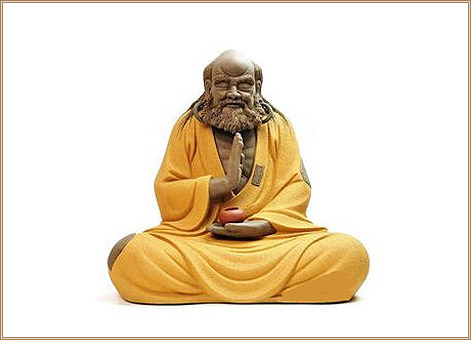
Bodhidharma 菩提達磨
Here we will examine the rise of Chán 禪, of special interest is the transformation of Tathāgata Chán (rúlái chán 如來禪) into patriarch Chán (zǔshī chán 祖師禪), how the Buddha was effectively replaced by the ancestor during the Golden Age of Chán in China.
I. - BODHIDHARMA (菩提達磨) AND THE CHAN (禪) LINEAGE
Bodhidharma (Pútídámó 菩提達磨, or simply Dámó 達磨, early 5th century CE), the earliest and a major legendary figure in Chán, traditionally said to have brought it to China. We know very little about Bodhidharma, and we have no contemporary information on him. Later accounts were layered with legend, but most accounts agree that he was either a South Indian or Persian monk who travelled to southern China and subsequently moved northwards. Traditional sources are not agreed on when Bodhidharma came to China. One early account claimed that he arrived during the Liú Sòng 劉宋 period (420-479), and later accounts dated his arrival during the Liáng 梁 dynasty (502-557), but he was primarily active in the Northern Wèi (386-534).3 Modern scholars date him around the early fifth century, so that the 6th century can be said to be "the Bodhidharma Century." According to a well known account, Bodhidharma, failing to make a favourable impression in southern China, headed northwards to Northern Wèi and lived in a cave near the Shàolín monastery 少林寺. It was in this connection that legends about his association of Chinese kungfu arose. While living in the cave, he was said to have "faced a wall for nine years, not speaking for the entire time." A version of this legend says after sitting in meditation for that long his legs atrophied,8 which is why East Asian Daruma "wobble" dolls (bùdǎowēng 不倒翁) have no legs! Another famous legend says that he fell asleep for seven years into his nine years of wall-gazing. Angry with himself, he cut off his eyelids to prevent it from happening again.10 It is said that, when his eyelids fell to the floor, the first tea plants sprouted up; and thereafter tea would provide a stimulant to help keep Chán students awake during meditation. Similarly, we only know of his death through legends, where one of them says that, after the nine years, Bodhidharma "passed away, seated upright." Another legend says that he simply disappeared, leaving behind the Yìjīn Jīng 易筋經 (literally, "Muscle/Tendon Change Classic"), a qìgōng 氣功 manual (though this has been doubted by several martial arts historians).
The Chán root quatrain
THE BUDHIDHARMA VERSE
The traditional Chán view has been that the famous quatrain or four slogans originated with Bodhidharma, and that they contain the essence of Chán, thus:
教外別傳 jiào wài bié zhuàn 不立文字 bú lì wén zì 直指人心 zhí zhĭ rén xīn 見性成佛 jiàn xìng chéng fó
A special [separate] transmission outside the teachings, do not depend on written words, directly point to the human mind, see one‘s nature and become Buddha.
T2008.360a24-360c12 & 2008.364c9-364c24
Contemporary writers following orthodox Chán views, regard this quatrain as the product of the Táng period, reflecting the rise to prominence of Chán during the "golden age," that is, the 8th and 9th centuries. The truth is that these slogans were separately found in works dating before the Sòng, but they do not appear together as a quatrain until well into the Sòng. They were then attributed to Bodhi,dharma in a collection of sayings of Chán master Fānghuì 方會 (or more colloquially, Hui or Huai)17 (992-1064), preserved in the "Chrestomathy from the Patriarchs‘ Hall" (Zǔtíngshìyuàn 祖庭事苑 TX64.1261), compiled by Mù‘ān Shànqīng 睦庵善卿 (du) in 1108. It was the early Sòng historian and scholar-monk Zànníng 贊寧 (919-1001) who attributed this three-line verse to Bodhidharma, thus:
直指人心 zhí zhĭ rén xīn 見性成佛 jiàn xìng chéng fó see one‘s 不立文字 bú lì wén zì
Directly point to human mind, nature and become Buddha, do not depend on written words.
Significantly, the first line, "A special [separate] transmission outside the teachings" was missing in this ancient verse.
The first line—"a special [separate] transmission outside the teachings" (jiào wài bié zhuàn 教外別傳) —was controversial from the start, as already mentioned. The most common line was the last, or rather the first half (two characters) of it—"see one’s nature" (jiàn xìng 見性)—which was an old Daoist idea, promoted by Dàoshēng 道生 (535-434), a disciple of Kumāra,jīva, well known for his Daoist learning. The first full line—(jiàn xìng chéng fó 見性成佛) "see one’s nature and become Buddha"—first appeared in the commentary to the Nirvāṇa Sūtra, in a statement attributed to the Koguryo monk Sēnglǎng 僧朗 (5th-6th cent)20 before the Táng dynasty. And the two middle lines—"do not depend upon written words" (bú lì wénzì 不立文字) and "directly point to the human mind" (zhí zhĭ rén xīn 直指人心)— became well known only at the end of the Táng period.
The controversial first line—"a special transmission outside the teachings" (jiào wài bié zhuàn 教外別傳)—was said to be found on the tomb inscription of Línjì Yìxuán 臨濟義玄 (d 867), attributed to his disciple, Fēngxué Yánzhǎo 風穴延沼 (896-973), and appended to the end of the Línjí lù 臨濟錄, 21 the record of Línjì‘s teachings. However, as the Japanese Zen scholar, YANAGIDA Seizan, has pointed out, the historical authenticity of this inscription is very uncertain.22 It is more certain, however, that this first line was first documented in the Zǔtáng jí 祖堂集 ("Anthology of the Patriarchs‘ Hall"), compiled in 952. It is mentioned in the Jǐngdé chuándēng lù 景德傳燈錄 ("The Jingde Era Record of the Transmission of the Lamp"), completed in 1004, and where it was attributed to Guìshēng, in his biography. We are now certain that this first line was not the invention of Bodhidharma, the Línjì or anyone of the Táng Chán tradition. In fact, it is perhaps not earlier than the Tang dynasty, certainly not before the 5th-6th centuries.
At the start of the 12th century, the saying, "a special transmission outside the teachings," was mentioned in the list of Chán sayings attributed to the Chán patriarch Bodhidharma in Zǔtáng jí 祖堂集 (952). Connecting the Línjì line and Bodhidharma was the culmination of identity-building for the Línjì lineage by its own members. The inclusion of this quatrain into the Línjì record was clearly for the sake of legitimizing the Línjì lineage during the Sòng dynasty to compete for the support of the elite, which was a common practice then. The current version of the Chán quatrain is also found in an edition of the Línjì lù dated 1120.
The character jiào 教 in the first line means "religion" (and as a verb jiāo means "teach"), but is often mistranslated as "scripture" which would be jīng 經. In the second line, wénzì 文字 does not mean "word" but "(Chinese) character, written word." In other words, Chán does not reject any sutra or scripture. This means that for the Chán tradition (as with early Buddhism), it is the spirit of the teaching, not the word of the teaching that is the true transmission. This is further supported by the next two lines: such a transmission occurs through the living word, and as such is a direct transmission from teacher to pupil, or from one person to another (that is, not through books or a dead medium). That Chán and Zen reject scriptures interestingly is a western scholarly construction due to a simple mistranslation! This may explain the fact that Chán and Zen are the most prolix and verbose of Buddhist schools.
WÚYUÈ (吳越), FǍYǍN CHÁN (法眼禅) AND THE WÉN MONKS
One of the most successful, if not the most successful, Buddhist kingdoms of ancient China was the Wúyuè kingdom 吳越 (907-978), whose capital was at Hángzhōu 杭州. The king of Wúyuè highly respected the Chán patriarch Fǎyǎn Wényì 法眼文益 (885-958), and was deeply influenced by his teachings. In fact, 10th century China was dominated by the practitioners and supporters of the Fǎyǎn lineage, many of whom were of great fame and influence. The Fǎyǎn circle regarded Chán as the quintessential apex of all Buddhism, which it viewed as an indispensable force in the creation of a civilized society. Driven by this vision of a Buddhist utopia, the Wúyuè rulers made the building and rebuilding of Buddhist institutions and sites their central concern. The Mt Tiāntái complex was rebuilt, and new Buddhist centres, such as the Yǒngmíng 永明 temple in Lín‘ān 臨安 (west of Hángzhōu), constructed. Ambassadors were sent to Japan and Korea to collect copies of important texts no longer found in China. In due course, the monastics of Wúyuè built a great reputation for themselves and Buddhists throughout China were drawn to its monasteries.
The leading Wúyuè official and monk Zànníng was a high official in the royal court of the second Sòng emperor, Tàizōng (太宗, r 626-649), the "emperor of letters" (wéndì 文帝). The wén (文) revival in early Sòng marked an important urning point in Chinese intellectual history, which "[f]rom its outset…signaled a return to native values and a study of the sources that discusses them,"26 and there was a consensus that this revival be guided by Confucianism. While some argued for the purist "classical" culture (gǔwén 古文), others (including Zànníng) proposed a broader view to embrace innovative forms. This was the period of the "lettered monks" (wénsēng 文僧). Understandably, Zànníng, who was himself a prolific literato, proposed that Buddhism be a part of this Sòng renaissance, that is, to be included in the new definition of "culture" (wén 文), but was strongly opposed by the Confucianists. Although he did not succeed in his proposals, his learning and writings continued to impress and influence the emperor and the court. In other words, he was himself a Buddhist wén master. Zànníng‘s numerous works reflected his broad knowledge of the Chinese literary tradition, but sadly none of these works survived.
WÚYUÈ: ZÀNNÍNG (贊寧) AND YÁNSHÒU (延壽)
Wúyuè Chán continued the old Táng traditions, but its patriarchs distinguished themselves with the syncretic harmonization between Chán and Huáyán (by Wényì 文益, 885-958), between Chán and Tiāntái (by Désháo 徳韶, 891-972), and between Chán and Pure Land (by Yánshòu 延壽, 904-975). Wúyuè Chán was officially represented at the Sòng court by Zànníng. Zànníng accepted the three-line Táng verse attributed to Bodhidharma (that is, without the first line) and accepted Bodhidharma‘s teachings as a branch of the larger tradition coming down from Shakyamuni. Zànníng held the view that those who took Chán to be independent of the ainstream teaching did not understand that
The scriptures are the words of the Buddha, and meditation (Chán) is the thought of the Buddha: there is no discrepancy whatsoever between what the Buddha conceives in his mind and what he utters with his mouth.
>Zànníng, T50-790a
Zànníng‘s inspiration was Zōngmì 宗密 (780-841), a patriarch of both Chán and Huáyán, and who presented a harmonious syncretism of Chán and Buddhism as a whole. Zōngmì was also the model for Yǒngmíng Yánshòu 永明延壽 (904-975), the leading Wúyuè Chán authority. Yánshòu, as such, advocated the practice of Chán in accordance with Indian Buddhism, opposing those who "have become attached to emptiness, and (whose practice) is not compatible with the scriptures" (T48.961b), following the words of Zhìyĭ and the Tiāntái school. According to Yánshòu, it is necessary to engage in two types of meditation practice, namely, calmness (shì 事) and insight (lǐ 理), in order to awaken. Calmness may arise from common activities such as worship, etc.29 Those who "become attached to emptiness"—that is, those who devoted themselves to cultivating insight at the expense of engaging in mindfulness of common daily activities—should learn to calm their minds, for example, by focussing on their breath. Meditation practice, in other words, should be harmonized between calm and insight.
OPPOSING VIEWS. Some Chán teachers outside of the Wúyuè community saw the two conceptions of "harmony between Chán and the scriptures" and "a special transmission outside the scriptures" as competing epistemologies. The former was a form of rationalism, a view that scripture is a means of communicating the truth, while the latter was a sort of mysticism, a view that enlightenment is beyond word and thought, and that scripture is incapable of conveying it. Simply put, the early Sòng Chán debate was whether Chán was rationalist or an independent mystical tradition. Sòng Chán is generally presented as denying rationalism in favour of "a special transmission outside the teachings" that "does not depend on written words," taking the two slogans as a couplet. Here, both phrases point to the common principle that enlightenment, as experienced by the Buddha and transmitted through the patriarchs, is independent of verbal explanations, including the Buddha‘s teachings as scripture and later doctrinal elaborations.
This view was rejected by Wúyuè Chán, which regarded the injunction, "do not depend on written words" and the principle of "a special transmission outside the teachings" as opposing ideas. Wúyuè Chán accepted Bodhidharma‘s warning against attachment to scriptures and doctrines, but did not accept that this warning amounted to a categorical denial of scripture. However, as Chán became established in the Sòng, its priests and officials rose to challenge the Wúyuè Chán view, and insisted on an independent tradition outside the scriptures.
In short, the view that Chán was "a special transmission outside the scriptures" was a post-Táng innovation, a view rejected by the Wúyuè Chán tradition and generally unaccepted today, too. We will now examine how the Línjì line, during the Sòng period, successfully argued for official recognition as "a special transmission outside the teachings," claiming for Chán a unique identity in Chinese Buddhism.
CÁODÒNG (曹洞) ASCENT
Before the time of Dàhuì Zōnggǎo (大慧宗杲 1089-1163), when the gōng’àn 公案 was not yet a developed form, the predominant Chán practice form was the so called "silent illumination meditation" (mòzhào chán 默照禪) of the Cáodòng 曹洞 school, which had been moribund then. However, during early 12th century, it had a suprising growth spurt and flourished well enough to attract the support of the literati. Apparently, this Cáodòng renascence proved disruptive of the other groups, especially the powerful Línjì, After all, literati and funds were finite, and the Cáodòng success had diverted support and resources away from the Línjì.
Although the Cáodòng ascent began even before Dàhuì, it was only when he came to Fújiàn 福建 in 1134, that he realized its extent, mainly as a result of Qīngliǎo Zōngjué 清了宗珏 (also known as Zhēnxiē Qīngliǎo 真歇清了 1091-1152), the abbot of the prestigious Xuěfēng sì 雪峰寺 (Snow Peak Monastery) in Fuzhou 福州 since 1130 (Jiànyán 4th year 建炎四年). Dàhuì expressly resented the Cáodòng success, especially concerned that the literati were caught up with "silent illumination," 30 which was actually very traditional meditation. Dàhuì vehemently denounced Qīngliǎo and his meditation, and almost all his attacks on silent illumination Chán were in the form of epistles to the literati or in his sermons given to the literati.
Dàhuì‘s attacks against the Cáodòng had one interesting characteristic: they were sharp but lacking any point. Take for example this characteristic excerpt from one of his epistles to the literati:
Heretical teachers teach literati to regulate the mind and to do quiet-sitting, completely separating themselves from all matters, ceasing and resting. This is clearly a case of using the mind to cease the mind, using the mind to rest the mind, and using the mind to apply the mind. Practicing in this way, how can they not fall into the realm of [dead-end] dhyāna and annihilation like the nonBuddhists and the Hīnayānists?
Dàhuì yǔlù 大慧語錄 T47.923b9-12
Throughout his attacks, he rarely specified what exactly was wrong with silent illumination Chán or why its followers "misunderstood" Chán enlightenment. There was a very good reason for Dàhuì‘s very biased and blanket attack on Cáodòng. After all, the Cáodòng system of silent illumination Chán was very little different from traditional meditation, and which was well taught by the Cáodòng masters, especially Hóngzhì Zhèngjué 宏智正覺 and Qīngliǎo Zōngjué 清了宗珏 (both students of Dānxiá Zǐchún 丹霞子淳, 1064-1117). The point is that Dàhuì was not concerned with the difference in meditation: there was very little significant difference between his system and that of Cáodòng. He attacked Cáodòng especially for its teaching silent illumination Chán to the literati. When he realized that too many members of the literati were studying under Cáodòng masters, his concern reached panic level. And so, as we shall see, just as Shénhuì was to the Northern School, Dàhuì was to Cáodòng! Significantly, in his attacks, Dàhuì onsistently presented his warnings against silent illumination meditation together with his advocacy of his gōng’àn meditation method.
Even though Dàhuì‘s gōng’àn meditation was meant for monastics, he astutely and freely now prescribed it for the literato laity. His Machiavellian cunning worked, since the gōng’àn meditation was easier to do and fit in more easily with the literati‘s busy lives. And the silent illumination method became so discredited through Dàhuì‘s attacks that "it was never used again in a positive sense." Here again we have a very good example of how a great master‘s wrong view was piously taken up by the admiring laity in the manner warned by the (Ahitāya) Thera Sutta (A 5.88).
JǏNGDÉ CHUÁNDĒNG LÙ (景德傳燈錄) AND FÓZǓ TǑNGJÌ (佛祖 統紀)
In critical studies of texts, internal evidence or lack of them, especially in a number of texts, can be helpful in ascertaining the facts. The Jǐngdé zhuàndēng lù 景德傳燈錄 ("The Jingde Era Record of the Lamp Transmission"),38 an influential transmission record promoting the Fǎyǎn lineage compiled by fellow Wúyuè monk Dàoyuán 道元 (du), a Korean, is oddly inconsistent with the mood of harmony between Chán and the scriptures referred to in the writings of Yánshòu and Zànníng. Although it was a Wúyuè work, it was strongly sectarian, emphasizing transmission verses and "encounter dialogues." It is a style that was at odds with conventional Buddhism and "harmony between Chán and the scriptures." In fact, its strong sectarian tone became the model for the new style of Buddhist biography prevalent in Sòng Chán, which emphasized lineage as the basis for sectarian identity.
Even more interesting, as Albert Welter points out, are the two prefaces—one by Yángyì and the other by Dàoyuán—to the Jǐngdé zhuàndēng lù, but only one is appended to it. The preface by Yángyì 楊 億 (974-1020), a prominent Sòng official who re-edited the text and provided it with the title by which we know it today, is appended, and is the standard edition. However, the preface by the original compiler of the text, Dàoyuán, was preserved separately.
Yángyì ‘s preface reveals that Dàoyuán‘s original transmission record had been edited by leading Sòng officials, headed by Yángyì himself. Since Dàoyuán‘s original compilation is no longer extant, it is difficult to assess how the text had been changed. Dàoyuán‘s original title for the work, Fózǔ tǒngjì 佛祖 統紀 ("Complete Chronicle of the Buddhas and the Patriarchs"),40 suggests harmony between Chán and the Buddhist tradition, but Yángyì ‘s bowdlerized revision, the Jǐngdé zhuàndēng lù, showed otherwise. This disparity is clearly hinted at in their respective prefaces. Dàoyuán‘s Chán practice was consistent with Wúyuè Chán, especially in promoting a "myriad practices are employed according to differences among practitioners," as advocated by Yánshòu. Yáng¬yì , on the other hand, projected Chán as a "special practice outside the scriptures," which promoted Chán exclusivity and undermines pluralism. Yángyì ‘s reinterpretation of Chán showed the prominence that Chán had in Sòng society, and the role that the Sòng literati played in determining Chán ideology. In fact, Yáng¬yì , more than any other figure, was responsible for establishing Chán as "a special transmission outside the scriptures" in official Sòng Chán circles.
THE TIĀNSHÈNG GUǍNGDĒNG LÙ (天聖廣燈錄)
When we look at any scripture, especially when it is printed in a neat volume or set of volumes, we may have the impression that they were put altogether in the same neat manner. But religious texts, even the early Buddhist canon, have a complicated history of being an open canon at first, and then closed at some point in the religion‘s history. Similarly, we often hear or read about Chán and Bodhidharma‘s famous quatrain, and we think that must be a very ancient saying. But the reality, even more so the history, of such received wisdom is very complicated. The history of institutional Buddhism in imperial China was closely link with the court. There is clear evidence of this in the Sòng period, when the Línjì lineage asserted its supremacy with the publication of the Tiānshèng guǎngdēng lù 天聖廣燈錄. It was compiled by Lǐ Zūnxù 李遵勗 (988-1038)—the son-inlaw of emperor Tàizōng 太宗 (r 976-998), brother-in-law of the emperor Zhēnzōng 真宗 (r 998-1023), and elder relative of the emperor Rénzōng 仁宗 (r 1023-1064)—so that even the text bore the reign title, Tiānshèng 天聖, and the emperor himself contributed a preface.
Upon completion, the Guǎngdēng lù was admitted to the Buddhist canon, following the precedent of the Chuándēng lù 傳燈錄 before it, and with it, Línjì‘s reputation was further enhanced. Línjì‘s teachings were recorded in toto in the Guǎngdēng lù for the first time. He became the official transmission link down from Mǎzǔ (677-744), Băizhàng (749-814) and Huángbò (d 850). As Welter has noted, Huángbò was not the only, or even the best candidate as Línjì‘s Dharma-master, nor was the route to Línjì the only possible choice for Chán orthodoxy.42 The point here is that the patriarchal status was one of prestige, not spirituality.
According to the Tiānshèng guǎngdēng lù, the interpretation of Chán as a "special transmission outside the scriptures" was not the innovation of Bodhidharma or Línjì, as suggested in later tradition. The first mention of "a special transmission outside the scriptures" in the Tiānshèng guǎngdēng lù was in the biography of Chán master Yèxiàn Guìshēng 葉縣歸省 (late 10th-early 11th cent), from the Guǎngjiào 廣教 Temple on Mt Bǎo‘ān 寶安山 in Sūzhōu 蘇州, a recipient of the patriarch‘s purple robe (zǐyī 紫衣). He is reputed to be "cold and severe, tough and frugal and that even patch-robed monks respected and feared him." Guìshēng used the phrase in connection with a sermon in which he tried to explain the meaning of Bodhidharma‘s coming from the west,
達磨西來 Dámó xī lái 法傳東土 fǎchuán dōngtǔ 直指人心 zhízhǐ rénxīn 見性成佛 jiànxìng chéngfó 況以西來的意 kuàngyǐ xīlái de yì 教外別傳 jiàowài biézhuàn
When Bodhidharma came from the west and transmitted the Dharma in the eastern lands (ie, China), direct pointing to the human mind, see one‘s nature and become a Buddha.... What is the meaning of his coming from the west? A special transmission outside the scriptures.
TX78.1553.496a23-b2
This same link between Bodhidharma‘s message and the interpretation of Chán as "a special transmission outside the scriptures" is found in the biography of Chán master Shíshuāng (or Nányüán) Chǔ-yuán 石霜(南源)楚圓 (987-1040) of Mt Nányüán 南源山 in Yuánzhōu 原州 (early 11th cent). As the teacher of both Yángqí fānghuì 楊岐方會 (992-1049) and Hénglóng Huìnán 横龍慧南 (1002-1069), heads of the two branches that dominated the Línjì lineage since the Sòng, the influence of Chǔyuán‘s interpretation was of great significance for the future of Sòng Chán.
THE BUDDHA‘S FLOWER AND MAHĀ KĀŚYAPA‘S SMILE
"The World-Honored One spoke: "I possess the True Dharma Eye, the Marvelous Mind of Nirvana, the True Form of the Formless, the Subtle Dharma Gate that does not rest on words or letters but is a special transmission outside of the scriptures. This I entrust to Mahakasyapa.”
By these words, first transmission between two buddhas occurred. Nothing more than the Buddha holding up a flower to his assembled monks and one of them, and Mahakasyapa, smiling in response. This the acknowledgement of one buddha to another that his mind and the disciple’s mind are one and the same mind.
A large part of my works are spent understanding and translating the big Master's teachings (sutras, dokuments) of this lineage, a difficult task requiring great mindfulness and patience; however, these documents are not just to give the disciple a record of her predecessors, but also to deeply experience a connection to all those who have gone before to carry the Buddha’s Way forward to us. It is both humbling and deeply gratifying to be included in such illustrious company. But the Buddha says that the true Dharma Eye is a special transmission outside of sutras, so what actually is transmitted. The understanding that "all beings are Buddha nature" helps me see that everything we need to know is already inside us - there is nothing anyone else can give me. Our true nature may still be covered by desire, aversion, or delusion. This is the work of a teacher to help disciples free themselves of these "coverings" When this has been deeply accomplished, the mind of the student, the teacher, and all the ancestors are the same. And that mind is "passed" from warm hand to warm hand. - heart to heart
Yao Dong (@Xing Long Tang and Puji Temple, Budapest)
The Tiānshèng guǎngdēng lù did not link the phrase "a special transmission outside the scriptures" to Bodhidharma, but it has a story that is innovative. It is said that a "special transmission" was first made by Shakyamuni himself to Kaśyapa: once Shakyamuni held up a flower, and Kāśyapa responded with a smile at the assembly. This is one of the most famous Chán stories illustrating a key event advocating a silent transmission independent of the written word. Shakyamuni‘s Dharma transmission to Kāśyapa is noted in the Jǐngdé zhuàndēng lù 景德傳燈錄 as a transmission of "the pure Dharma-eye, the wondrous mind of nirvana," but there is no mention of the famous episode of the flower and Kaśyapa‘s smile. The flower story was first mentioned in Chán transmission records in the Tiānshèng guǎngdēng lù, understandably a key text that established Sòng Chán identity in terms of "a special transmission outside the scriptures."
In the apocryphal story, Shakyamuni, acknowledging Kaśyapa‘s smile upon presenting the flower to the assembly, announces: "I possess the treasury of the true Dharma-eye, the wondrous mind of nirvana. I entrust it to Mahā Kaśyapa." The treasury of the true Dharma-eye (zhèngfǎyǎn zàng 正法眼藏), the essence of Shakyamuni‘s teaching, was not yet linked in any way to the expression "a special transmission outside the scriptures," but would be soon. In fact, by Sòng times, the expression the treasury of the true Dharma-eye became a catchword of Ch‘an ideology, but it no longer referred to the tripiṭaka. It signified, rather, a special "collection" (piṭaka; tsang) [zàng 藏] that comprised no texts at all but simply the "‗eye" or formless essence of the dharma—the Buddha-mind or enlightenment itself. It was also used to refer to the sayings of Chan patriarchs, especially when collected and used as kung-an.
Foulk 1999: 230 & n19)
The appearance in the same transmission record, the Tiānshèng guǎngdēng lù, of an interpretation of Chán as a tradition independent of Buddhist scripture, and a story about how that independent tradition began, showed how actively Chán promoters laboured to reconstruct their image in the early Sòng. The first version of the story to make explicit what was only implicitly drawn in the Tiānshèng guǎngdēng lù was the Dàfán tiānwáng wèn fójuéyí jīng 大梵天王問佛覺決疑經 ("The Scripture on the Heavenly Lord Mahā,brahmā Asking the Buddha About His Doubt" @ CBETA X01n0027_001). According to the Dàfán tiānwáng wèn fójuéyí jīng version of the story, as Shakyamuni sat before the assembly holding the lotus-blossom given him by brahmin, Kaśyapa, without saying a word, broke into a smile. The Buddha then proclaimed, "I possess the treasury of the true Dharma-eye, the wondrous mind of nirvana, miraculous Dharma-methods born of the formlessness of true form, not established on words and letters, a special transmission outside the scriptures, etc." and went on to entrust it to Kaśyapa. This proclamation, as it were, directly linked the Buddha‘s teaching, "the treasury of the true Dharma eye, the wondrous mind of nirvana," etc, to the Chán identity as "a special transmission outside the teaching." Ironically, scripture is used under the pretext of scriptural authorization! There is no evidence that the Dàfán tiānwáng wèn fójuéyí jīng existed before the Sòng, and it is widely regarded as apocryphal— evidently the story of Shakyamuni and Kāśyapa was invented for the purpose of legitimizing the lineage.
This new persona of Chán as "a special transmission outside the scriptures" was moulded through a uniquely Chán literary form, the gōng’àn 公案 (Jap: koan) or "public notice," or more figuratively, "case studies.". The Wúménguān 無門關 (Gateless Gate), compiled at the end of the Sòng period, includes the story of the interaction between Shakyamuni and Kāśyapa as one of its case studies, following the version established in the apocryphal Dàfán tiānwáng wèn fójuéyí jīng. Through the inclusion of the story in the Wúménguān, put the final touch, as it were, on Chán as "a special transmission outside the scriptures," so that this is the received tradition to this day.
CHÁN VIOLENCE
Chán Buddhism can be very violent—in words and stories, at least. But where did this institutional violence come from? And is it to be taken literally? The history of Chán can be viewed as how a Chinese Buddhism evolves from being a reflection of an early Indian teaching to the light that is utterly Chinese. During the 8th century, mostly through efforts initiated by the unscrupulous southern priest Shénhui, Chán become more Chinese than it was Buddhist.
Indeed, we can find examples of provocative resonances even in small collections such as the Dhammapada and the Apadāna,49 for example:
Cut down the forest, but not the tree. From the forest arises fear. Having cut down the forest and growths, O bhikshus, you are forest-free!
Dh 283
Having killed mother and father, wnd two kings, and having slaughtered A realm together with its governor–– the brahman wanders unafflicted.
Dh 294
Let go of the front. Let go of the back. Let go of the middle. Crossing to the far shore, with the mind released from everything, do not again undergo birth and decay.
Dh 348
The man without desire, who knows the unmade, who has cut off the link, who has got rid of the occasions (for quarrels and rebirth), who is an eater of what is abandoned by others— he is indeed the highest person.
Dh 97; DhA 7.8/2:187
The nature of the Chinese language—pictographic, monosyllabic and concrete—has less penchant for addressing the abstract. Chinese imageries tend to be measureable or nature-related (this latter, like the verses of the Thera,gāṭhā and Therī,gāthā). Abstract and conceptual terms in Chinese, especially religious language, ultimately derived from the Indian Buddhist texts, for example, tathāgata,garbha (womb of Buddhahood), tathatā (suchness), dharma,dhātu (realm of reality), "Buddhatva (Buddha-nature), and nirvāṇa.
The Chinese Buddhist mode of philosophical discourse is usually laconic and palpable (brief and appealing to the senses), and often enough, to extremes. See this Wúménguān51 case 21, Wumen‘s "Dry dung-stick" (Érshíyī yúnmén shǐjué 二十一 雲門屎橛), for example:
雲門、因僧問、如何是佛。 門云、乾屎橛。
A monk asked Yúnmén, "What is Buddha?" Yúnmén replied, "A dry dung-stick!" (gānshǐjué; Jap kanshiketsu)
Wúménguān case 21: T 48.295c5)
The author of this koan certainly did not find this inspiration from the early Indian texts: there is no such imagery there. This philosophical earthiness is indigenous to China and is licenced by such examples as the renowned description of the Dao in Zhuangzi, in the chapter entitled "Knowledge rambling in the north" (Zhībě iyóu 知北遊):
東郭子問於莊子曰: - Dōngguōzi wèn yū "所謂道,惡乎在." - Suǒwèi dào, wù hū zài. 莊子曰:"無所不在." - Zhuāngzi yuē: “Wú suǒ bùzài.” 東郭子曰:" 期而後可." - Dōngguōzi yuē: “Qī ér hòu kě” 莊子曰:"在螻蟻." - Zhuāngzi yuē: “Zài lóuyǐ.” 曰:"何其下邪?" Yuē: “Hé qí xià xié?” 曰:"在稊稗." Yuē: “Zài tíbài.” 曰:"何其愈下邪?" Yuē: “Hé qí yù xià xié?” 曰:"在瓦甓." Yuē: “Zài wǎ pì” 曰:"何其愈甚邪?" - Yuē: “Hé qí yù shèn xié”? 曰:"在屎溺?" Yuē: “Zài shǐ nì.” 東郭子不應。 Dōngguōzi bú yìng
Zhuāngzi Dongguozi asked Zhuangzi, saying, Concerning the Dao, where is it to be found? Zhuangzi replied, "There‘s nowhere it is not found. Dongguozi said, "You must be more specific. It is in lowly bugs (like crickets and ants). Is there a lower example? It is in barnyard grass. Is there a still lower example. It is in a clay tile. Is there an extremely low example? In that dung! To this Dongguozi gave no reply.
Zhuangzi 22
CHÁN LINEAGES
John McRae‘s instructive study, Seeing Through Zen (2003), explores the distinctive and central role of lineage in Chán Buddhism. He notes that this "genealogical" approach is so central to Chán‘s self-understanding that, while not without precedent, had unique features. It is "relational (involving interaction between individuals rather than being based solely on individual effort), generational (in that it is organized according to parent-child, or rather teacher-student, generations) and reiterative (ie, intended for emulation and repetition in the lives of present and future teachers and students." (2003: 8)
Two important reasons may be proposed for the key role of lineage in Chán Buddhism.56 The first is where the Chán community did not rely on any one Mahāyāna text as its foundation scripture. The Huá-yán school, for example, took the Avataṁsaka Sūtra (Huáyán Jīng) as their key text; and the Nirvana school, the Nirvāṇa Sūtras (Nièpán jīng 涅槃經), and so on. Without a special text to identify itself with, the Chán school had to resort to the conception of lineage. But this is not a very strong reason. The main reason for the Chán emphasis on lineage was a powerful Confucian influence regarding how best Chán can legitimize itself, especially in an urban society where the powerful and the affluent decided the rules. Scholars like John Jorgenson and John McRae note that the Chán lineage closely paralleled Chinese funerary practice:
My contention is that Chán provided a format for Buddhist practice that matched the patron implied by Chinese funerary customs. The starting point for this analysis is John Jorgenson‘s observation of the structural similarities between Chán lineage assertions of the eighth century and funerary practice, in which the organization of halls venerating Chán patriarchs was seen to resemble that of conventional ancestral halls. From a broader perspective, the proliferation of Chán lineages mimics that of conventional family genealogies, creating a parallel realm of filiation between living and dead. Indeed, where conventional genealogies are devoted individually to reparate family groups, Chán "transmission of the lamp" texts create an entire universe of fictive relationships. Thus each individual practitioner is securely placed within a generational successive network, and all of those succession relationships are concatenated into a massive network of interlocking identities. Where conventional family genealogies were in dialogue both with each other and with contemporary social practice, "transmission of the lamp" texts provide the Chán lineage system with its own global context for the idealization of religious identity.
McRae 2003: 148; reparagraphed
McRae offers a detailed criticism of the Chán lineage tradition, but he also notes that it was so central to Chán that it is hard to envision any claim to Chán bereft of lineage claims. For example, in Japanese Sōtō (Chin Cáodòng 曹洞), lineage charts are a central part of the Sanmatsu, the documents of Dharma transmission, and which is regularly included in the daily chanting in Zen temples and monasteries. In Japan, during the Tokugawa period (1600-1868), some questioned the lineage system and its legitimacy. The Zen master Dokuan Genko (1630-1698), for example, openly questioned the necessity of written acknowledgment from a teacher, which he dismissed as "paper Zen." A number of Tokugawa teachers did not adhere to the lineage system, and they were called mushi dokugo (無師獨悟 wúshī dúwù, "independently awakened without a teacher") or jigo jisho (自悟自証 zìwù zìzhèng, "self-awakened and self-certified").
Modern Chán-Seon-Zen Buddhists generally downplay the significance of the dynamics of the lineage system, encouraged in part by the revelations of academic researches into Chán history, and focus more on the spiritual study and contemplative practice. There is also a tacit openness to other Buddhist traditions, especially early Buddhism.60
The Gong An (公案)
GONG AN (公案) AND KĀNHUÀ CHÁN (看話禪)
Historically (that is, as understood by the Chán traditions), a gōng’àn 公案 (Jap: koan) was a brief saying, dialogue, or anecdote culled from the hagiographies (chuandēng lù 傳燈錄) and discourse records (yǔlù 語錄) The practice of commenting on sayings of the patriarchs was first attested in mid-tenth century Chán literature.62 Before that, passages from the patriarchal records that were used for commentary were known as "old cases" (gǔzé 古則). As Foulk notes, such a practice "was not simply a means of elucidating the wisdom of ancient patriarchs for the sake of disciples or a larger audience. It was also a device for demonstrating the rank and spiritual authority of the master himself." (2000: 17).
Discourse records (yǔlù 語錄) compiled from the latter half of the 11th century onwards often contain separate sections entitled "Comments on old cases," that is, jǔgǔ 擧賈 "citation of transactions" (literally, "proposals to buy"), or niāngǔ 拈古 "raising an ancient precedent," or niāntí 拈提 "raising a point for question or analysis." The phrase niāngǔ 拈古 is often found in the compound, niāngǔ sònggǔ 拈古頌古, which means to raise (niān) and analyze an ancient precedent, and then to write and attach one’s own verse to it. This is a well-known Chán-Seon-Zen literary genre.64 Such cases or stories, when used in instructions, were never quoted in full, but merely alluded to, which assumes the student‘s or audience‘s familiarity with them. Apparently, such exchanges were done orally.
By the mid-11th century, these discourse records include sections called "verses on old cases" (sònggǔ 頌古, lit "ancient eulogies"). Unlike the well-known old cases, which were only alluded to, these verse commentaries (written ad hoc by Chán masters) were often cited in full alongside the root case (běnzé 本 則), so that the audience would better appreciate the verse commentary. This also suggests that such verses were not as well known as the old cases. The old cases came to be called gōng’àn (公案, Jap koan), but it is not exactly clear how this occurred. The term gōng’àn was used figuratively at first. It was not even a Buddhist term, but came from the mediaeval Chinese legal system. The term itself could refer to a Chinese magistrate‘s desk; but it could also refer to a complex legal case, where gōng (公) means "public, official, unbiased" and àn (案) means "legal case." One of the oldest references to this is found in the mid-11th-century by Xuědòu Chóngxiǎn (d 1052) in his "The Monk‘s Xuědòu‘s Verses on Old Cases" (Xuědòuxiǎn héshàng sònggǔ 雪竇重顯和尚頌古), that is, the original 100 cases serving as the basis for the Blue Cliff Records.
Over a century later, Yuánwù Kèqín 圓悟克勤 (1063-1135), in his commentary on "The Monk‘s Xuědòu‘s Verses on Old Cases" (preserved in his "Blue Cliff Collection," Bìyán jì 碧巖紀), clearly uses the term gōng’àn to refer to the dialogues themselves as texts. In his pointers (chuíshì 垂示) and prose commentaries (píngchàng 評唱), Yuánwù calls the old cases gōng’àn throughout. As noted by Foulk, Yuánwù was implying that when Xuědòu collected and attached comments to them, he was taking on the role of a magistrate.
In its earliest usages, term gōng’àn was used to compare the spiritual authority of a Chán master with the legal authority of a magistrate, not in reference to the old cases of the patriarchs (id). As such, we have stories of Chán masters dealing "thirty blows" (sānshí bang 三十棒), when the student was guilty of the wrong response. By the end of the 13th century, during the Mongol Yüan dynasty, the old cases were like legally binding documents, "the idea being that they should be regarded as authoritative standards for judging spiritual attainment" (Foulk 2000: 18). This is very clear in "Extensive Records of the Monk Zhōngfēng" (Zhōngfēng héshàng 中峰和尚廣錄) by Zhōngfēng Míngběn (中峰明本, 1263-1323), a Yüan priest following the tradition of Dàhuì Zōnggǎo. Zhōngfēng gives this detailed definition of the gōng’àn:
Gong‘an may be compared to the case records of the public law court. Whether or not the ruler succeeds in bringing order to his realm depends in essence upon the existence of law. Gōng 公 or "public" is the single track followed by all sages and worthy men alike, the highest principle which serves as a road for the whole world. Àn 案 or "records" are the orthodox writings which record what the sages and worthy men regard as principles…. The koans do not represent the private opinion of a single man, but rather, the highest princeple received alike by us and by the hundreds and thousands of bodhisattvas of the three realms and the ten directions. This principle accords with the spiritual source, tallies with the mysterious meaning, destroys birth-and-death, and transcends the passions. It cannot be understood by logic; it cannot be transmitted in words; it cannot be explained in writing; it cannot be measured by reason. It is like a poisoned drum that kills all who hear it, or like a great fire that consumes all who come near it.... The koans are something that can be used only by men with awakened minds who wish to prove their understanding. They are ertainly not intended to be used merely to increase one‘s lore and provide topics for idle discussion. The so-called venerable masters of Chán are the chief officials of the public law courts of the monastic community, as it were, and their collections of sayings are the case records of points that have been vigorously advocated. Occasionally, men of former times, in the intervals when they were not teaching, in spare moments when their doors were closed, would take up these case records and arrange them, give their judgment on them, compose verses of praise on them and write their own answers to them. Surely they did not do this just to show off their erudition and contradict the worthy men of old. Rather, they did it because they could not bear to think that the great Dharma might become corrupt. Therefore they stooped to using expedient means in order to open up the wisdom eye of the men of later generations, hoping thereby to make it possible for them to attain the understanding of the great Dharma for themselves in the same way.
Furthermore, it was Zhōngfēng who wrote that gōng’àn is an abbreviation for gōngfǔ zhī àndú (公府之案 牘), that is, a "public legal record" in the Táng dynasty. A watershed in gōng’àn history occurred in the Sòng dynasty, with the development of "the Chán of phrase-contemplation" (kānhuà chán 看話禪). The "word or phrase" (huàtóu 話頭) to be contemplated on was usually derived from a root case (běnzé 本則) of the ancient dialogues. The foremost promoter of this new Chán technique was Dàhuì Zōnggǎo (大慧宗杲 1089-1163), the most famous of the Sòng priests. Foulk conjectures that Dàhuì, feeling that the "silent illumination Chán" (mò-zhào chán 默照禪) was vainly trying to gain insight (guān 觀, "see," Skt vipaśyanā) without first attaining calm (zhǐ 止, "stop," Skt śamatha). But, he notes, this was probably pure rhetoric. For, "[i]f Ta-hui had been interested only in promoting the cultivation of trance states [dhyāna] as a means of cutting off discursive thought, he could have avoided the words of the patriarch altogether and recommend other, entirely non-discursive objects of mental concentration, such as the devices (biànchù 遍處, Skt kasiṇa)." (2000:23).
The key fact remains, as Foulk points out, that the gōng’àn is a literary genre. This also explains why a gong‘an does not make "sense" to the uninitiated. Gong‘ans have power to function in the Chán mind and society "because what identifies words or actions as ‗expressions of the mental state of enlightened people‘ is never the semantic content of the words themselves, but only their attribution to a Ch‘an patriarch in a flame history [dēnglù 燈錄] biography, a discourse record, or (subsequently) a koan collection." (2000: 39).
The gōng’àn (Jap koan) come a long way, and has today entered into popular vocabulary to mean "a paradox, enigma, or enigma." There is even a Singapore website where the koan is recommended for mothers (which may not really be a bad idea, after all)!69 We shall also discuss below how the koan be useful as a counselling tool. But, first, let us discuss a topic that is closely related to gōng’àn and counselling, that is, doubt.
CHÁN AND DOUBT
Discounting metropolitan Chán, elitist Chán, and other unchanly Cháns, traditional or spiritual Chán stresses on mindfulness, mental focus and liberation by transcending language and thought. Language and thought may be the most common way we function or communicate, but they are not always the most effective means of personal experience or of communicating. Language (because it is a human construct) and thought (because it is a mental construct) are the inevitable grounds for doubt or "feeling of doubt" (yíqíng 疑情), as Chán often say, and doubt is one of the greatest hindrances to mental cultivation and spiritual realization. Yet the very same poison, properly understood, is the door to wisdom. One of the most enduring and instructive aspects of Chán is its penchant for religious doubting; not that doubting is good in itself, but that it is the beginning of inquiry that leads to liberating wisdom. To doubt is to know that we are still unliberated, and ntails seeking the conditions for the doubt. In this sense, doubting leads to knowing. But it is a dynamic kind of doubting, not that of perceiving our inabilities or weaknesses. Doubt arose in the young Bodhisattva‘s mind when he saw the first three sights of an old man, a sick man and a dead man (manifestations of the three great evils), but it also moved him to seek a solution for them—and he became Buddha.
Doubt prevents enlightenment; it is like a closed door. To open the door of doubt is to destroy doubt. This is done by "directly pointing to the human mind" (jiào wài bié zhuàn 教外別傳), that is, by transcending or bypassing the limitations of language and directly see true reality (a notion important in early Buddhist meditation, too). The most famous way in which this was done was through the koan, that is, stretching the limits of language so as to totally demolish it.
Dàhuì Zōnggǎo took the idea of doubt very seriously and warned his students that they must always doubt words, so as not to be fooled by them. In fact, they should doubt their very existence. He said, "Many students today do not doubt themselves, but they doubt others. And so it is said, ‗Within great doubt there necessarily exists great enlightenment‘."72 This was taken up five centuries later by the great Japanese Rinzai teacher, Hakuin (1685-1768), who also taught that "great doubt" was necessary for one to awaken to reality.
GĀOFĒNG YUÁNMIÀO (高峰原妙)
In China itself, even just before Dàhuì, his own teacher, Yuánwù Kèqín still treated the "feeling of doubt" (yíqíng 疑情) in the traditional early Buddhist manner, "as something harmful to faith, which should be diligently avoided at all times—but especially so in the course of gōng’àn investigation."73 It was Yuánwù‘s famous disciple, Dàhuì who, as we have seen, turned his teaching on doubt on its head, "re-conceiving it instead as the principal force driving one toward enlightenment."The most systematic presentation of Dàhuì‘s kānhuà chán, however, is found in the Chányào 禪要 ("The Essentials of Chán")75 by the Yüan-dynasty Línjì master, Gāofēng Yuánmiào 高峰原妙 (1239-1295). Gāofēng‘s main work was to systematize kānhuà chán practice into three principal parts he called "the three essentials" (sānyào 三要): (1) the faculty of great faith (dàxìn’gèn 大信根); (2) great passionate intent (dàfènzhì 大憤志); and (3) the great feeling of doubt (dàyíjíng 大疑情). Gāofēng treated faith as the "essence" (tī 體) of doubt, and enlightenment as the "function" (yòng 用) of doubt —drawing on the popular apocryphal Awakening of Faith (Dàshéng qǐxìn lùn 大乘起信論, T32.1667). Since the foundation of virtually all sinitic or East Asian Buddhism is that enlightenment is immanent in all beings, Gāofēng explained that ultimately all that needed to be done to achieve enlightenment was simply to have faith wholeheartedly, that is, let go of the notion that we are not enlightened! His rationale is found in the Chányào: "Faith is the essence (tī 體) of doubt, enlightenment is the function (yòng 用) of doubt. When faith is a hundred percent, so too is doubt. When doubt is a hundred percent, so too is enlightenment." This was of course Gāofēng‘s view, one which Dàhuì approved of.
DÀHUÌ ZŌNGGǍO (大慧宗杲)
The 12th -century Chán master Dàhuì Zōnggǎo 大慧宗杲 (1089-1163)78— often referred to as Dàhuì, for short—a disciple of Yuánwù Kèqín (圓悟克勤 1063-1135)79 and the 12th generation of the Línjì line of Chán, was best known as a keen advocate of the gōng’àn or koan (公案) for achieving Chán enlightenment. Dàhuì had humble beginnings: when he was 10, a fire wiped out his family fortune.80 In 1101, when he was 13, he abandoned his classical education that had hardly begun to become a monk. Dàhuì was tonsured at 16 and formally ordained (received the precepts) the following year. As an intellectually brilliant young monk, he was drawn to the works of the innovative Yúnmén Wényǎn 雲門文 偃 (864-949).81 While reading through a Mahāyāna text, he was said to have had a profound religious experience. The following year, he began his wanderings to study under different teachers, sometimes sampling several teachers in a single year. Most of these teachers were from the Cáodòng 曹洞 school, whose system he purportedly mastered within two years, but only to denounce them later!
In 1116 (when Dàhuì was 27), he met the retired Northern Sòng prime minister and lay Buddhist scholar, Zhāng Shàngyíng 張尚盈 (1043-1122), and a little later, Hán Zǐcāng (韓子蒼 c1086-1135), a relative of the imperial family, both of whom would be important influences in his life. In due course, he was recommended to study under Yuánwù Kèqín, joining his assembly in 1125. He vowed to himself,
I will give this master nine summers as the limit. If his teaching does not differ from that of other masters, and if he gives me his approval easily. I will then write a treatise denouncing Chán Buddhism, instead of taxing my spirit and wasting precious time on it. I will devote myself to a sutra or a treatise, and cultivate virtue so that I can be reborn as a Buddhist.
Ziyong, Nianpu, Hsuan-ho 6th year, p 17b
After only six weeks, he had an enlightenment experience during one of Yuánwù‘s sermons. However, getting his enlightenment certified by Yuánwù was another matter. Yuánwù told him to work on the koan, "The East Mountain walks over the water." On one of the sessions, Yuánwù rebuked Dàhuì, "Your great problem is that you do not doubt the words enough!" (bùyí yǔjù, shì wéi dàbìng 不疑語句, 是為大病). He was then given a new koan, "To be and not to be—it is like a wisteria leaning on a tree" (yǒ jù wújù, rúténg yīshù 有句無句, 如籐依樹). He reported to his master three or four times daily, only to be told he was wrong each time. After some six months, he made a total of 49 such attempts. Only in the fifth month of 1125, did he gain the Chán breakthrough.86 Even if this account was exaggerated, it showed that either Dàhuì was a very patient and determined student, or that Yuánwù was making sure that he had weaned Dàhuì‘s pride. Considering that Dàhuì was still as samsaric as before, perhaps even more so at this point, this account was to blandish him which would further enhance the prestige of his lineage.
In the same year (1125), Dàhuì was awarded the purple robe (zĭyī 紫衣) by Lushun, the Minister of the Right (yòudàchén 右大臣). The following year, however, the Jürchen Tartars (Nǚzhēn 女真) captured the Northern Sòng88 capital, Biànjīng 汴京 (modern Kaifeng, Henan), along with the imperial household. The capital was moved south, marking the beginning of the Southern Sòng (Nán Sòng 南宋 1127-1279). Dàhuì also moved south and continued teaching both monks and laymen. It was at this time that he began his severe criticisms of the Cáodòng (Jap: Sōtō) school, ridiculing it as the "heretical Chán of silent illumination" (mòzhào xiéchán 默照邪禪).
Dàhuì‘s strong denunciation of the Cáodòng school reminds us of Shénhuì‘s evangelical attacks on Shénxiù and promoting Huìnéng in the 8th century. However, while Shénhuì was against a whole school (the "Northern" school), Dàhuì, however, only attacked a meditation system—he was against sitting meditation—and in its place promoted the gōng’àn. However, there is an important similarity in both cases: their denunciations (which are documented) were aimed at attracting attention and legitimization to their own lineage by gaining the support of the gentry and literati. As an accomplished intellectual priest, Dàhuì became very popular with the literati and gentry, as well as Chán priests. In 1137, at the age of 49, the Southern Sòng prime minister, Zhāng Jùn 張浚, a pupil of Dàhuì, appointed him as abbot of Jìng shān 徑山 monastery in the Southern Sòng capital of Lín‘ān 臨安 (west of Hángzhōu 杭州). Within a few years his community grew to two thousand, and among his lay followers were many high ranking officials. Dàhuì became the acknowledged Buddhist leader of the Southern Sòng dynasty. (Yu 1979: 216)
His connections with the gentry would be his own undoing (for a while, anyway). A high official he was close to—a follower named Zhāng Jiǔchéng 張九成90—fell out of favour with the new prime minister, and consequently Dàhuì, too, lost his imperial honors and ordination certificate (he was laicized). In 1141 (at 52) he escaped to Héngzhōu 衡州 (in Hú‘nán 湖南), where he was caught, and exiled to live with the army at Jiǔchéng 九成, living there for 14 years.
When he reached 62, he was transferred to Méixiàn 梅縣 (present-day Méizhōu 梅州, NE Guǎngdōng 廣東), then notorious for plagues and bad weather, and lived there for five years. Some fifty of Dàhuì‘s priests died there in a plague (Ferguson 2000: 441). Throughout these difficult years, Dàhuì continued teaching the Línjì tradition, attracting both gentry and commoners. Finally, in 1155, Dàhuì (at 77) was pardoned and allowed to return to his former monastery at Jìng shān where he continued teaching until he died five years later in 1163. Zhāngjùn, his pupil who made him abbot of the Jìng shān monastery, eulogized, aptly in worldly Sòng language, that "he had the will of a loyal subject and the heart of a compassionate bodhisattva. Unlike the Hīnayāna sravakas and pratyeka-buddhas, he is not tired of samsara and he does not selfishly desire nirvana."Dàhuì wrote only one work, a collection of koans of preceding Chán masters, entitled Zhèngfǎyǎn zàng 正法眼藏 (the Treasury of the True Dharma Eye).93 He also compiled with a fellow monk named Takuei,a work entitled, Chánlín bǎoxùn 禪林寶訓 (Jewel Teachings of the Chán Monastic Tradition), an anthology of instructions of Chán abbots on the virtues and ideals of monastic life. His sermons and letters were collected by his disciples into thirty juan, entitled Dàhuì pǔjué chánshī yǔlù 大慧普覺禪師語錄 (T1998).
DÀHUÌ‘S WOMEN DISCIPLES
A significant contribution of Dàhuì is that he not only gave Dharma transmission to the nun Miàodào 妙道 (fl 1134-1155?), but also designated her as his primary Dharma heir. Although Miàodào was not the first woman Chán master, she was the first who was historically documented. It is said that she lived as a laywoman in a monastery for a while. Her Chán enlightenment in 1134 had a great impact on Dàhuì‘s teaching. A few stories about her illustrate the fear that monks had of sex and how this "held them back": she once appeared naked in the meditation-hall (chántáng 禅堂; Jap: zendo) in order to show them that the disturbance was in their own minds. She received imperial approval to be a teacher and abbot, and was eventually ordained. Dàhuì had another nun pupil, Miàozōng (妙總 alias Wúzhù 無著 1095-1170),96 ordained in 1162, who was also outspoken and controversial. From 1163 (a year after ordination) to her death, she was abbess of Zīshòu 資壽寺 nunnery, in Píngjiāng prefecture 平江府 (Píngjiāng fǔ, Sūzhōu in Jiangsu). She also received the purple robe.97 Both women were recorded in the imperially sanctioned lineage text, "Essentials of the Society of Linked Lamps" (Liándēng huìyào 聯燈會要)
DÀHUÌ ZŌNGGǍO (大慧宗杲) AND KĀNHUÀ CHÁN (看話禪)
Táng-dynasty Chán and Sòng-dynasty Chán were very different in character.99 Doctrinally, Táng Chán taught "intrinsic enlightenment" (běnjuémén 本覺門), while Sòng Chán taught "experiential [acquired] enlightenment" (shǐjuémén 始覺門). The seeker of "experiential enlightenment," having awakened from delusion, went on to cultivate or experience enlightenment. This practice was unique to Sòng Chán and is referred to as "phrase-observing meditation" (kānhuà chán 看話禪), made famous by Dàhuì Zōnggǎo. Dàhuì exerted a very strong influence in Korean Seon through the works of Jinul 知訥 (Zhīnè, 1158-1210) and Japanese Zen through Dōgen 道元 (Dàoyuán, 1200-1253). Dàhuì often used the famous koan on "Zhàozhōu‘s Dog," the very first one in the Wúménguān.
趙州和尚、因僧問、 Zhàozhōu héshang, yīnsēng wèn 狗子還有佛性也無。 Gǒuzi hái yǒu fóxìng yě wú 州云、無。 Zhōu yún: Wú
A monk asked the monk Zhàozhōu: Has a dog the Buddha-nature or not? Zhōu answered: Wu!
Yī Zhàozhōu gǒuzi 一趙州狗子; Wúménguān case 1
"Zhàozhōu‘s Dog" is an excellent example showing that koans only work, or work best, with the Chinese or Chinese-based languages (those of East Asia). This koan is best used in the original Chinese version, if any Chán enlightenment is to be experienced. The huatou is in the word wú, which should not be translated. Having understood the koan, we then simply let the wú settle into our consciousness. The mind will open to it just like that. The purpose of the koan is to break the mental mould of thought constructions or mental rut caused by language. The reason is clear: the pictographic nature of the Chinese language easily reifies an idea, and at least in pre-modern times, not suited for abstract thinking, unlike an alphabetbased language (like Sanskrit and Pali). Understandably, pre-modern Chinese civilization was better known for its practical philosophical and scientific ideas rather than abstract philosophy or religions.
Dàhuì‘s style of instruction using koans profoundly influenced all the Línjì (Jap: Rinzai) teachers after him both in China and Japan. Although he viewed koan practice as the most effective way to Chán enlightenment, he saw this practice in his time as becoming a superficial literary study. In a characteristically Chán fashion, he ordered the suppression of his own teacher‘s masterly collection of koans, the Blue Cliff Record (Bìyán lù 碧巖錄; Jap: Hekiganroku)103, burning all copies and the wooden printing blocks, effectively taking the venerated text out of circulation for the next two centuries.
If we follow Dàhuì‘s track record so far, it is not difficult to see his book-burning as being less than magnanimous. Book-burning had occurred before in China—the most notorious being the one ordered by the first emperor, Qín Shǐ Huáng 秦始皇 (259-210 BCE), who, to silence critics of his autocratic imperial rule, burned their books, especially those of the Confucian scholars, and banished or executed them. Dà-huì found his teacher‘s work, the Blue Cliff Record, a distraction from his plans to have the Chán world revolve around himself. He was phenomenally successful in his plans.
His innovative teaching became known as the "phrase-observing meditation" (kānhuà chán 看話禪) [see above]. Although he believed that koans were the best way to Chán enlightenment, being deeply influenced by Daoism and Confucianism, he declared, "If one achieves a genuine breakthrough, then (one realizes that) a Confucian is no different from a Buddhist, and a Buddhist is no different from a Confucian; a monk is no different from a layman, and a layman is no different from a monk; an ordinary man is no different from a sage, and a sage is no different from an ordinary man."104 Either that, or he saw him self as even above China‘s greatest sages, which would then point to a megalomanic tendency or delusions of personal grandeur.
"TRANSMISSION OF THE LAMP" (傳燈錄, Chuándēng lù)
By the 11th century, koans of earlier masters were eagerly collected and some teachers even began to invent their own koans. The most famous example of an anthologies of earlier koans is the Chuándēng lù 傳燈錄 (The Transmission of the Lamp)105 compiled by Dàoyuán 道原 in 1004, comprising over a thousand koans ranging from those of the ancient patriarchs and masters to the disciples of Fǎyǎn in the 10th century. An early example of the second type of koan anthology are the recorded sayings of the Línjì master, Fényáng Shànzhāo 汾陽善昭 (947-1024). It has 300 koans found in three collections. The first collection consists of old koans, for each of which Fenyang wrote a verse summarizing the general meaning of the koan in poetical language. The second consists of his own koans appended with his own answers. The third collection comprises old koans, along with his alternate answers to them. These three collections became the models for later koan-based exercises.
The rise of koan anthologies was mainly due to an internal crisis. After the persecution of Buddhism in 845, the Chán masters were dying without the rise of new ones. Within fifty years, a whole generation of illustrious Chán masters died one after the other: Guīshān 圭山, 853; Huángbò 黄檗, 855; Déshān 德山, 865; Línjì 臨濟, 866; Dōngshān 洞山, 869; Yǎngshān 仰山, 891; and Cáoshān 曹山, 900. Chán Buddhism—unlike Tiāntái or Huáyán, both of which were scripture-based, or Pure Land which was faith-based—had always stressed on personal religious experience, that is, the Chán enlightenment and its certification by living masters. In a Buddhism that is heavily Confucianized and subtly Daoized, even enlightenment had to be measured and certified. The Chán master decided when his pupil was ready for training and for what sort of training, and when he had awakened. Beginning with Dàhuì, the enlightenment tool was the gōng’àn or koan. The days of Suzuki and romantic Chán are over: scholars now know that the koan was not always a skilful means. Chinese scholar Yu writing about Dàhuì, comments:
It was hoped that through the collection of earlier koans, and through the concentrated meditation on these koans, the original experience of enlightenment could be re-enacted. Suzuki thought this development indispensable for the survival of Ch‘an after the passing of those charismatic leaders of T‘ang.108 However, as we shall see, this emphasis on koan exercise was indeed a double-edged sword. It could grant more life to Ch‘an, but if handled wrongly, it could also kill its very life.
Yu, "Ta-hui Tsung-kao and Kung-an Ch‘an," 1979: 219
HOW TO HUATOU (話頭)
Generally, a koan refers to a mind-altering dialogue or an event that took place between a Chán master and his student. As Garma CC Chang notes, "In short, koan means a Zen story, a Zen situation, or a Zen problem."109 The Chán monks of Sòng however seldom used the term gōng’àn 公案, but more often used huàtóu 話頭, and referred the meditation on a koan as cān huàtóu 参話 頭 or kān huàtóu 看話頭. Literally, huà means ‗‗speech, remark, sentence," and tóu means either the beginning or the ending of something, because the Chinese sentence can be read left-to-right (as in English) or in reverse. Since tóu literally means "head," we can take it as the part of the sentence that we should "head for," that is, grasp: it is, as it were, the handle of the sentence, its catchphrase. Thus, combined, huàtóu means, "the head (or handle) of a sentence," or more technically, this is the lemma or headword that holds the essence of the sentence, as it were. When you grasp the huàtóu, you have a handle on the sentence‘s meaning. You have found the finger pointing to the moon: now, you only need to you look directly to the moon. You need neither the finger nor the pointing any more. While koan refers to the whole situation or event, huatou means specifically the critical word or key point of the situation. The distinction between a koan and a huatou may be illustrated by Dàhuì‘s favourite koan, "Zhàozhōu‘s Dog." A monk asked master Zhàozhōu, 110 "Does a dog have the Buddha-nature?" Zhàozhōu answered, "Wu!" (see above). The entire dialogue is called a koan, but a Chán practitioner should think of neither the question nor answer. Instead, he should concentrate singlemindedly heartedly on the key-word wu—this is his huatou.
A huatou may be regarded as a pregnant thought which, when subjected to proper examination will reveal the nature of the human mind. Nan Huai-chin explains it this way:
In the contemporary idiomatic Shanghai dialect, if you want to ask someone, "What is your problem?" or "What do you want?" you say, "What is your huatou?" Whenever a thought starts to form, this is the beginning of a sentence. But what are the origin and whereabouts of an incipient thought? This is indeed a great problem. To find out the source of this thought—this is huatou. It is the beginning of a phrase, a problem. To work on a huatou is the method of dwelling upon the origin and root source of this phrase. This "dwelling upon" includes the combined effort of studying, guessing, experiencing, observation, contemplation and quiet deliberation of the huatou.
NAN Huai-chin, Chán yú dào gài lùn 禪與道概論, 1968: 77 f
From a romantic distance, all this sounds mystical, but such an exercise, as noted by Buswell, does not fit well into a meditation regime aimed at concentration:
[H]wadu [Korean for huatou] is not intended to guarantee a state of samādhi but a state in which both the calmness of samādhi and the perspicuity of prajñā are maintained… If one were to try to place the state of mind engendered through kanhwa pratice in the stages in Buddhist meditation continued in the Theravāda school, I believe it would be rather more akin to "acess concentration" (upacāra-samādhi), which accompanies ten specific types of discursive contemplations.
Buswell, The Korean Monastic Experience, 1992: 159
However, it is less problematic if we situate the koan practice Buswell mentions here as an anti-conceptualizing strategy, which has a vital role in early Buddhist meditation. The Vitakka,saṇṭhāna Sutta (M 20) teaches a mental strategy against conceptualizing (worrying, etc) by way of "thought reduction," where the distracted meditator stops and examines the troubling thought, just as it is, thus:
If, bhikshus, while the monk is not minding and is disregarding those thoughts, there still arises in him evil unwholesome thoughts connected with desire, hate or delusion, then he should attend to the stilling of the thought-formation (vitakka,sakhra,santhna manasikarato) [by identifying the causes]111 of those evil unwholesome thoughts. Then the evil unwholesome thoughts are eliminated and disappear. By their elimination, the mind thus stands firm internally, settles down, becomes unified and concentrated.
SIMILE OF THE WALKER.
Bhikshus, just as a man finding no reason for walking fast, walks slowly; finding no reason for walking slowly, stands; finding no reason for standing, sits down; finding no reason for sitting down, lies down—thus giving up an awkward posture for an easy one—even so should the monk get rid of the evil unwholesome thoughts by attending to the stilling of the thought-formation. Then the evil unwholesome thoughts are eliminated and disappear. By their elimination, the mind thus stands firm internally, settles down, becomes unified and concentrated.
M 20.6/1:120 = SD 1.6
The Dharma section explains the method theoretically, while the simile passage actually gives a graphically clearer way how to let go of the troubling mind. There is a catch here: the teachings here by themselves are usually difficult to grasp at first. Even if we have a total intellectual grasp of the passage, it still remains to be personally applied and seen to work for ourselves. A mature meditation teacher trained in the early Buddhist teachings would generally advise the student to do any of these processes as we are inclined to:
- Simply notice the nature of the troubling thought-process: how it arises, peaks and passes away, or
- A simple trick here is to ask ourselves "Why am I thinking like this?" or better "What is going on here?" or,
- Identify the key-word in the troubling thought, eg "worry," and examine this huatou: "What is this thing?" "What is going on here?" (Once you are familiar with the practice, you do not even need to ask the question—the answer will arise just by calmly looking on.)
As these are not intellectual questions, we do not in any way try to answer them: we simply ask the questions as often as necessary, but most importantly remaining silent so that the answers would arise on their own. It is as simple as that, but be prepared to be surprised and stilled by the answer when it does arise. This is an early Buddhist application of doubting the mental words that trouble us. The idea is to doubt the problem that is troubling us. An apocryphal Chán story goes that the second Chinese patriarch, Huìkě 慧可, approached Bodhidharma to be his pupil, but Bodhidharma rejected him, retorting, "When the snow turns red!" So Huìkě stood in the snow for a while reflecting, and then cut his arm and offered it to Bodhidharma; the snow at his feet was red—with Huìkě‘s blood! Accepted at last as Bodhidharma‘s disciple, Huìkě then asked him:
"My mind is not at peace: please still my mind!" "Bring your mind here, and I will still it for you!" "I have searched for my mind, but I simply cannot apprehend it." "There, I have stilled it for you!"
傳燈錄 Chuándēng lù, T51.219b
No one, not even a serious Chán practitioner, would take this account anything more than a story, even if an edifying one. We are simply unlikely to give an arm or a leg to get a problem solved. Furthermore, even if we were desperate enough to part with a piece of our body, Bodhidharma‘s answer is not likely ever to solve our problem: we are not Huìkě! The story is the koan; look for its huatou. See it directly in your mind. Do not think, do not seek. The answer will come. It is so hard-hitting, yet so crystal clear to you, there is no more need for asking, or worrying, or doubting. Now apply this to your problem, the next time you have one.
DEAD-WORD (死字, ǐzì) AND LIVE-WORD (活字, huózì)
One of the most distinctive Chán hermeneutic tools was that of the "dead-word" (sǐzì 死字) and "live-word" (huózì 活字) dichotomy. These words were attributed to Dòngshān Shǒuchū (洞山守初 d 900), a pupil of Yúnmén Wényǎn (雲門文偃 864-949). These terms were also used by Dàhuì, from whom the Korean monk Chinul (Zhīnè 知訥 1158-1210) and later Korean tradition adopted them.116 The "live-word," on the other hand, allows no conceptualizing conjured up by the deluded mind. As Dàhuì described it, "This one word is the weapon which smashes all types of wrong knowledge and wrong conceptualization." As understood and used by Chán teachers, any theoretical description, whether of Chán or not, would be considered "dead-word," while any teaching not intended to explain, but to enlighten us, would be a "live-word." "Dead-words" are nice to talk about, but are soon tiresome and not helpful in spiritual cultivation, or often a hindrance to enlightenment. Even the Chán teachings or the koan, when contemplated in a theoretical manner becomes dead-word, and Dàhuì warned his students to investigate the live-word, not to investigate the dead-word.
These two terms—dead-word and live-word—are remarkably close to the twin terms of explicit [definitive] (liǎoyì 了義, Skt nītârtha) and implicit [indefinitive] (bùliǎoyì 不了義, Skt neyārtha). In the meditation training of the early Buddhist tradition, the student is first given theoretical instructions about some suitable doctrine (such as the five aggregates), and the nature of mental hindrances. In the actual meditation practice, the student is often gently, sometimes abruptly, reminded or induced to let go of conceptualizing and experience the meditation object or state directly. This latter part is little different from the way that "live-word" is described, but we must remember that they are used in different systems of meditation. However, there is a Madhyamika catch here: we are still dealing with a duality here. Without the
dead-word, there is no living-word. The two are not verbal or cognitive entities, but merely our perception: we need to re-tune our perception, as it were, to see beyond the death of words, into the living word. We directly understand the dead-word when we see it as reflecting the present moment of our daily life (of course, this is only one way of explaining it). Generally, this task is easier with the guidance of a wise experienced teacher.
WHO IS FIT TO TALK WITH?
A wise teacher is the one who knows how to properly answer a questioner and help him in his problem. The Kathā,vatthu Sutta (A 3.67) recounts the Buddha‘s insightful advice on how a person should be judged by the way he treats the questioner. The main points are summarized here:
The four kinds of questions
1 When you are engaged in discussion with someone, you should know whether he is fit to talk with or unfit to talk with. He is fit to talk with
(1) if he categorically answers a categorical question; (2) if he gives an analytical or qualified answer when it is an analytical question; (3) if he counter-questions when a counter-question is needed; (4) if he puts aside a question when it should be put aside.
The four principles of discourse
2 A person is fit to talk with
(5) if he keeps to what is possible and what impossible; (6) if he keeps to agreed assumptions (7) if he keeps to known teachings; (8) if he keeps to proper procedure.
The threefold decorum of discourse
3 A person is fit to talk with, (9) if he does not evade the issue by wandering from one topic to another; (10) if he does not lead the discussion astray [off the point]; (11) if he does not show anger, aversion or discontent.
Further decorum of discourse
4 A person is fit to talk with, (12) if he does not put down [the questioner]; (13) if he does not crush him; (14) if he does not ridicule [laugh at] him; (15) if he does not grasp at his little mistakes.
Be attentive to a teacher
5 Note this in a person you are speaking with: (16) if he does not listen to you, he is not attentive; and (17) if he listens to you, he is attentive.
A 3.67/1:197-199 = SD 46.11
DO NOT GIVE ZEN ANSWERS!
A case in point is a "Buddhism and Science" symposium held in Singapore in July 2008. Two scientists and a monk presented parallels between, as advertised, "Buddhism and science." The hydrologist spoke of how our mind, when emotionally pent up (such beings angry) is like a flooding dam that suddenly breaks and floods the lowlands with widespread damage. The geneticist clarified that even when a chicken gene is put in soya bean, there is no "chicken" in it. And the monk (a pupil of a contemporary Chán master) then presented how Buddhism had progressed with brain science, presenting what were some kind of glimpses from the Sutta Discovery paper on "Consciousness and meditation" (SD 17.8c).
What is interesting, yet troubling, was that none of the questions asked from the floor were fully answered at all! Here are some typical exchanges that occurred (with the questions simplified):
Question: When does [sic] life begin? [Meaning how does Buddhism define life, etc.] Answer: (After some ball-passing as to which speaker should answer): At 60! Question: Can you explain how the four satipatthanas work on the triune brain during meditation? How does breath meditation help in the process here? Answer: Sounds like you know the answer; why don’t you tell me the answer!
The following passage is fairly representative of Dahui‘s sentiments regarding sitting meditation, and although his original intentions (that is, before worrying about the Cáodong ascendancy) were quite different, these words sound very familiar in our own times, especially of non-meditating modernists:
In recent years, heretical teachers sprang up within the sangha like wild weeds, and blinded the eyes of numerous sentient beings. When one does not use the koans of the ancients in meditation, he will be like a blind man without a walking stick and cannot advance even one step .... [Some people] think that Buddha Dharma and Chán cultivation are not dependent upon written words. Therefore they denigrated all koans as ready-made. They just sit in a ghostly cave on a dark mountain after their meals. They call this practice "silent illumination," "dying the great death," "the state before the birth of one‘s parents." They sit there until calluses appear on their bottoms, yet they still do not dare to move. On the contrary, they regard this as the gradual maturation of their effort.
Dàhuì yǔlù, juan 19, T47.890c-891a
Further, Dàhuì noted that those "heretical teachers" only had an intellectual understanding of Chán and koans:
Nowadays there are people who have never personally experienced enlightenment, but only know how to play intellectual tricks. Before they ascend the high seat in the morning, they would stay up all night, memorizing two phrases from this pamphlet [koan collection] and two phrases from that one. After pasting them together they present the end product like a bouquet. They can talk with great fluency, but people with clear eyesight know this is a ridiculous parody.
Dàhuì yǔlù, juan 13, T47.863b-c
Dàhuì fiercely attacked those Chán teachers who advocated "silent sitting" (zuòchán 坐禅), claiming that it would breed passivity, torpor and delusion. According to Dàhuì, passively sitting in meditation leads to drowsiness (hūnchén 昏沈), and intellectualizing the "meaning" of a koan only leds to conceptualization (diàojǔ 掉舉)—two foes equally deadly in the life of a Chán practitioner. Any seasoned meditator, however, would know that if such a simple practice is problematic, the critic obviously has either not tried it or not benefitted from it, or is simply unable to meditate. Perhaps this explains why there are many so-called "Chán temples" (chánsì 禅寺) in our midst without any chán (meditation)! How should we practise Chán then? Dàhuì claimed that the only effective way to avoid these two dangers and to realize our true mind by intensive concentration upon a koan. As he put it, if we failed to use a koan, then we would be like a blind man without a walking stick, unable to take even one step. But first, Dàhuì stressed that we should have faith in the method, and feel the urgency of the task. "In one‘s daily activities, one should [mentally] paste the words ‗life‘ and ‗death‘ on one‘s forehead and feel as if one owes someone a million strings of cash and the debtor is right outside the door asking for payment." Dàhuì‘s imageries clearly reflected his intellectual familiarity with the Sutras, but were applied to meditation. He directed these same ancient similes and reminders to his pet practice: the koan. On account of such worldly developments in the name of Chán and Zen, and their popular perception, the word Zen if often used today in the sense of "being fashionable" or "mystical." Not only are fashionable furniture and indoor decoration said to be "zen," there was in 2011 even a Hongkong 3-D erotic period movie called "Sex and Zen." The word "zen" has met its karma and joined the league of extrareligious words like jesuit (one given to cauistry or political cunning). It is instructive if we are to carefully reflect on how such developments occur.
II. - NORTHERN-SOUTHERN SCHOOLS CONTROVERSY
Shénxiù (神秀) and Huìnéng (慧能)
DISCIPLES OF HÓNGRĚN (弘忍)
An important landmark in Chinese Buddhism is the controversy or polemics arising between the northern and southern schools of pre-classical Chán (8th century). The lesson here is that in the dynamics of early Chán (especially during the Sòng period), history is often secondary to legend, and that truth and doctrine are secondary to rhetoric and propaganda. From the traditional records, as we have them, the controversy arose between two Chán factions—the northern and the southern schools—centering the status of "sudden enlightenment" (the subitist position) and the "gradual enlightenment" (the gradualist position). All this, as we shall see, was the machination of one unscrupulously zealous monk.
The best known account of the controversy is recorded in the Platform Sutra of the Sixth Patriarch (Liùzŭ tán jīng 六祖壇經). According to this Chinese text, both Shénxiù 神秀 (606?-706) and Huìnéng (慧能 638-713) were disciples of Hóngrěn 弘忍 (601-674), the fifth Chán patriarch. Hóngrěn, seeking a successor to the title of sixth patriarch, asked his disciples to compose a verse each that would demonstrate their respective levels of enlightenment.
All the other monks expected Shénxiù, the senior disciple, to be the successor. Shénxiù composed a verse which Hóngrěn publicly praised, but told Shénxiù in private that it fell short of the mark. When Huìnéng, then still a lay temple hand, heard about the contest, he instantly knew what to write but, being an illiterate manual worker130 (says the Platform Sūtra), had a temple page inscribe his verse on a wall. Hóngrěn, hearing of this verse, publicly declared that this verse was lacking, but late that night called the layman Huìnéng to his room and "transmitted his Dharma" to him, naming him as his successor as the sixth patriarch, and giving him the robe and bowl of Bodhidharma as tokens. In traditional Chán literature, Shénxiù‘s verse represents the gradualist position while Huìnéng‘s states the subitist position, and Hóngrěn‘s approval of the latter‘s verse is meant to show that the subitist position is the true teaching of the patriarchs.
In traditional Chán documents, the Northern School (Běizōng 北宗) of Shénxiù is represented as teaching "gradual enlightenment." Philosophically, "gradual" here does not necessarily mean taking an extended period of time to awaken, but indicates the dualistic view that differentiates enlightenment from ignorance, or practice from attainment. No matter what length of time one specifies from the beginning of practice to the enlightenment, it is "gradual" only because the two are viewed as separate. According to doctrine of Buddha-nature that was current in China from the 4th century onwards, all sentient beings have the capacity to become Buddhas. Teachings of "sudden enlightenment," which became standard doctrine within Chán after the controversy, held that all beings are inherently endowed with Buddhahood. As such, enlightenment takes literally no time at all, since practice and enlightenment are not separate. According to this view, the Northern School adhered to a position of untenable dualism, and was as such unorthodox.
The real situation was that this unchanly dispute over "sudden" versus "gradual" enlightenment was all machinated by the wily evangelist Shénhuǐ 神會 (688-762) as a struggle for religious orthodoxy and supremacy. It is of little interest to the ordinary Buddhists, suffering in samsara and seeking to get out. No amount of Chán philosophy could help them. Indeed, if the Chán school were ever to survive, it still had to use "gradual" methods for the dense masses. In fact, as Faure has observed, "most of the time, they merely concealed this fact with their ‗sudden‘ terminology" (1986: 117). The point is that Chán would not have survived if not for its words, shouts and disputes.
WHO WAS SHÉNXIÙ? (玉泉神秀 605-706)
Yùquán Shénxiù (玉泉神秀 605-706) was one of the most influential Chán Buddhist masters of his day, a patriarch of the East Mountain Dharma-door (Chin Tung-shan famen): this long name was often given the diminutive appellation "Northern School" by Shénhuì (神會670-762). Shénxiù was Dharma-heir of Hóngrěn. In late 700 the empress Wǔ invited Shénxiù to the capital at Luòyáng to teach Chán Buddhism. For the last five years of his life, Shénxiù travelled between the two capitals of Luòyáng and Cháng‘ān, teaching Buddhism before passing away at his monastery, the Dōngdū tiāngōng sì 東都天宮寺, sitting in meditation, in 706.The reigning emperor Zhōngzōng 中宗 (705-710) granted the posthumous title of Dàtōng chánshī 大通禪師 (Greatly Penetrating Dhyana Master), only the second time in Chinese Buddhism and the first for three hundred years that this imperial honour had been bestowed (McRae, 1986: 55).
The Léngjiā shīzī jì 楞伽師資記 (Records of the Teachers and Disciples of the Lankavatara) states that Shénxiù‘s last words were "Qūqūzhí" 屈曲直 that is, "bent over, curved, straight" (T85.2837.1290b13). The meaning of these words has puzzled many scholars. McRae thinks that they "might refer to some progressive perfection Shen-hsiu felt he had achieved. Or, taking the first two characters as a compound, one could read the statement as ‗the vagaries of the world are now straightened [in the state of nirvāṇa to come]‘" (1986: 54). The renowned Japanese Buddhologist YANAGIDA Seizan notes that qūqūjiāo 屈曲教 is a pan-chiao, or "doctrinal classification," term for an indirect method of teaching by which the Buddha brought his listeners to the ultimate truth in a step-by-step or even roundabout fashion, and as such he interprets the phrase as "the teachings of the expedient means have been made direct."
Although Shénxiù was the legitimate sixth patriarch of Chán Buddhism, the Southern School, at the instigations of Shénhuì, rejected him, and made counter-claims, splitting the Chán School. The Southern School promoted Huìnéng as their sixth patriarch, and this rivalry continued into the following century. Shénxiù saw himself as teaching in the "East Mountain" tradition of Hóngrěn but, on account of the machinations of Shénhuì in early 730‘s, was labeled as a teacher of the "Northern School" in subsequent Chán records.
Shénxiù was highly educated and steeped in Buddhist scripture. He interpreted the scriptures by way of metaphors of "skilful means" (Skt upāya, fāngbiàn 方便) for "mental contemplation mind," advocating the attainment of Buddhahood in all daily activities, here and now. Every act was seen as meditation practice. For example, he saw simple activities, like taking a bath, as a religious act. He taught that soap used to clean away dirt "is actually the ability of discrimination by which one can ferret out the sources of evil within oneself." Cleaning the mouth with toothpicks is "nothing less than the Truth by which one puts an end to false speech." Overt religious activities such as burning of incense were seen as "the unconditioned Dharma, which ‗perfumes‘ the tainted and evil karma of ignorance and cause it to disappear." (McRae 2003: 50). In meditation practice, Shénxiù taught that the student should develop the natural ability of the mind "to illuminate and understand all things" (McRae 2003: 53), and to see the emptiness of all things. He taught that there is a profound stillness in all things. A Northern School text known as the Five Skillful Means states: "In purity there is not a single thing… Peaceful and vast without limit, its untaintedness is the path of awakening [enlightenment]. The mind serene and awakening distinct, the body‘s serenity is the bodhi tree." (McRae 2003: 53).
Even though Shénxiù and the "Northern School" were subsequently attacked as teaching a gradualist approach to enlightenment, the Guānxīn lùn 觀心論 (Treatise on Contemplation of the Mind), a text which is "unquestionably written by him [Shénxiù]" (McRae 1986: 207) clearly states: "It does not take long to witness this (ie, to realize sagehood); awakening [enlightenment] is in the instant. Why worry about your white hair (ie, about your age)?" (id). It was Shénxiù‘s exhortations to constant, unremitting practice that gave Shénhuì the opening to attack the teaching as "gradualist."
In any case, Shénhuì‘s attacks on Shénxiù occurred some thirty years after Shénxiù‘s death. During his lifetime, and especially his relatively brief teaching in the capital cities of the Táng Dynasty, Shénxiù‘s teachings were received with widespread acceptance and reverence. The influence of Shénxiù‘s teachings on subsequent Chán doctrine and practices is, however, still a somewhat open question, especially the Northern School did not survive the political changes and social turmoil in the north. The Southern School, on the initiative of Shénhuì, flogged the dead horse that is the Northern School, and its received history became the dominant ideology for centuries to come.
Wǔ Zétiān (武則天 625-705)
RISE TO GREATNESS
The story of Wǔ Zétiān, the only woman to rule China as an empress, was contemporaneous with that of the sixth patriarch. We will study the Wǔ Zétiān story first as a backdrop to Huìnéng, and also because her story is significant in terms of a strategic study of Buddhist history, and is, in many ways, more complicated than the Huìnéng story. If there were ever a single woman who manipulated Buddhism to her worldly benefit for most of her adult life, and to affect a whole nation to boot, it would be Wǔ Zétiān 武則天 (r 625-705), personal name Wǔzhào 武曌, 135 often referred to as Tiānhòu 天后 "the Heavenly Empress Consort" during the Táng Dynasty and as Wǔhòu 武后 "the Empress Consort Wǔ" in later times. She was the only woman in the history of China to assume the title of Empress Regnant. As de facto ruler of China, first through her husband and her sons (665-690), not unprecedented in Chinese history, she then broke all precedents when she founded her own dynasty in 690, the Zhōu 周 (interrupting the Táng dynasty), and ruled personally as "the Sacred and Divine Empress Regnant" (Shèngshén huángdì 聖神皇帝) and its variations (690-705).
Her rise and reign was harshly criticized by Confucian historians but, after the 1950s, has been viewed under a different light. At the tender age of 13, the beautiful Wǔ Zétiān joined the emperor Tàizōng‘s 太宗 harem. Later, however, she became a nun, but then returned to the world to become a secondary consort of emperor Gāozōng 高宗, around 652. After vicious palace intrigues, she ousted the legitimate empress Wang (王皇 后 Wáng huánghòu), and in late 655, had her brutally murdered, and gained total dominance over the emperor, consolidating her power during the periods when he was too ill to rule. From 660 onwards she built up her power with consummate skill. During the time when Wǔ Zétiān had usurped the throne, apparently some Buddhist clerics saw this as an occasion for consolidating themselves. Antonino Forte, in his monograph on Buddhism during the Wǔ Zhào 武曌136 usurpation of the Táng throne, suggests that the Tantric priests Bodhi, -ruci and Mani,- cintana, tried to curry favour with the empress, by apparently interpolating the Sanskrit manuscript of the Bǎoyǔ jīng 寳雨經 (Rain of Jewels Sutra) to include explicit references to a female world-monarch (cakravarti). When Gāozōng 高宗 (r 650-683) died, he was succeeded by Zhōngzōng 中宗 (r 684, 705-710), but when he showed signs of being independent, empress Wǔ deposed him, and installed his brother, Ruìzōng 睿宗 (r 684-690, 710-712), as nominal emperor, with her as the power behind the throne. In 688, when some Táng princes rebelled against her, they were easily put down. A series of bloody purges followed, where many of the royal family and court officials were killed. For several years, her secret police had a free hand in rooting out all opposition.
By 685, the empress Wǔ had been carrying on an affair with the priest Huáiyì 懷義 (d 695), and during the next few years, Huaiyi would be progressively bestowed with greater and greater honours.139 Shortly after Wǔ Zétiān took the throne, she elevated the status of Buddhism to be above that of Daoism, officially sanctioning the religion by building temples named Dàyún sì 大雲寺 (Great Cloud Temple) in every prefecture of the regions of the two capitals, Luòyáng and Cháng‘ān, and also made dukes of nine senior priests.
WǓ AS MAITREYA (彌勒菩薩)
In 690, Wǔ Zétiān performed a series of ceremonies and rituals, preparing (that is, legitimizing herself in usurping the Dragon Throne, and so becoming the empress of a new dynasty, the Zhōu 周, and to become the only woman ruler in Chinese history. Her rise came at a time when women played an important role in public life, which was probably the result of the semi-foreign origins of many of the great clans that dominated Táng court life. Since the patriarchal Confucians were fervently against a woman being above them, much less as empress, Wǔ Zétiān astutely turned to Buddhism to legitimize her claims to the throne. Under such circumstances, the Buddhist priests were either obliged to assist her, or saw this as a great opportunity to promote the religion (or probably both, and making the best of the situation). From such documents as the Lìdài fǎbǎo jì, we know that she used two main strategies. Firstly, she claimed that she was the incarnation of Maitreya Buddha; secondly, she concocted the story that she has Bodhidharma‘s robe (which confered patriarchship upon the holder). In the same year (690), Wǔ introduced the presentation of the purple robe (紫衣 zĭyī), upon a group of priests, including her lover, the priest Huaiyi 懐義, as a mark of special favour. The earliest record we have on this event is found in the Jiùtáng shū 舊唐書 (Old Táng History):
Huaiyi, Faming and others made the Dayun jing, in which was displayed a series of signs [concerning the Heavenly] Mandate and in which it was said that Zetian was Maitreya who had descended to be born and act as the head of the Jambudvīpa…Huaiyi, Faming and others, nine people, were all enfeoffed dukes of a subprefecture and were given different objects: all were given the purple kāṣāya and a "silver bag for the tortoise."
Jiutang shu juan
According to Adamek, the princely purple robe, the imperial talisman, and fief, were indigenous Chinese symbols and substance of enfranchisement, free passage into ancestral ritual arena, heavenly sanction, and material privilege. The giving of the purple robe was merely a mark of imperial favour, not one of the talismans of imperial legitimacy (2000: 71). However, invoking Indian Buddhist mythology, she took the giving of the robe an act of merit that a universal-monarch (cakra,varti) gained from such a gift to the sangha. We should not miss the most significant point regarding empress Wǔ‘s conferring the purple robe upon eminent and favoured priests.
The presentation of the purple robe had an ancient precedent: purportedly, that of the Buddha bestowing a "gold-embroidered" robe on Mahā Kāśyapa. Only this time, it was Wǔ Zétiān who gave the robe. By this act, she had usurped the two highest positions of the Buddhist realm, that of the Buddha himself, and that of the patriarch who was the only legitimate person to hand down the patriarchal robe! All this might have worked well for the Buddhists. To enthrall and domesticate the other subjects at large, Wǔ played on important symbols, something deeply loved and easily understood by the traditional Chinese. Through an auspicious confluence of signs characteristic of her rule, she fashioned a dynastic identity in the time-honoured imperial way, that is, the relationship of name (such as the dynastic name Zhōu 周) and symbols (such as the tortoise, a Chinese symbol of longevity), to invoke universal harmony in terms of Han cosmology.
WǓ AS PATRIARCH-MAKER
In 692, Huìnéng, at Wǔ Zétiān‘s request sent Bodhidharma‘s robe to her at Luòyáng—so says the Lìdài fǎbǎo jì! She was said later to have given it to the monk Zhì- shēn 智詵 (609-702), who thus claimed to be the seventh patriarch in the lineage of the Băotáng monastery (Băotángsì zōng 保唐寺宗). The reason for Wǔ‘s pious generosity is recorded in a dramatic story of a duel between Zhishen and the Indian monk Trepiṭaka (said to be a mind-reader):
[Zhishen] imagined himself dressed in layman‘s garb looking toward the section office of the western market. Then Trepiṭaka said, "How can [you], a worthy (bhadanta) monk, wear layman‘s clothing and gaze into the midst of a market?" Shen [ie, Zhishen] said, "Very good, try it again." [Another similar scenario follows.] Shen said, "This time will be really good, try one more." Then right where he was, by relying on the Dharma he produced no thoughts at all. That Trepiṭaka searched throughout the Three Worlds, but in vain. The Trepiṭaka brahmin was filled with reverence and respect, and he bowed his head down at Shen‘s feet, telling the Venerable, "I did not know that in the country of the Táng there was Mahāyāna Buddha-Dharma…" [Empress Wǔ] Zetian saw that the Trepiṭaka had taken refuge in Chán master Shen. Zetian submitted a question to all the bhadanta: "Do the Venerables have any desires?" Shenxiu 神秀, Xuanyue 玄約, Laoan 老安 and Xuanze 玄則 all said, "We have no desires." Zetian asked Chán master Shen, "Does the Venerable have any desires?" Chán Master Shen, fearing that he would not be allowed to return home, complied with the will of Zetian and replied, "I have desires." Zetian further asked, "How can you have desires?" Shen replied, "That which is born has desire. That which is not born has no desire." At these words, Zetian was enlightened."
T51.2075.184a25-b9; Adamek‘s tr, reparagraphed
When Zhishen insisted on returning home, Zetian gives him the Bodhidharma-Huìnéng robe, and other gifts, including an embroidered image of Maitreya. Wendi Adamek notes the significance of this story:
It is significant that bestowal of the robe takes place in the context of an enlightenment experience signaling Dharma transmission, or mutual understanding between master and pupil, which was a frequent motif in Chán hagiographies. Here, however, the transmission is characterized by several kinds of inversion. First, the transmission of the sudden teaching, the identity between Buddha-Nature and ordinary function that is beyond words, finds its voice as the antinomian affirmation of desire. Second, it is the bestower who is awakened by the recipient. Third, a worldly ruler stands in for the Dharma ruler, Huineng, who is still alive at the time and is subsequently informed by the empress of the fate of his robe. Finally, the bestower is a woman and an empress, a lusus naturae [quirk of nature]—who perhaps not incidentally, was known for her sexual appetites and also for having had her lover ordained the better to bestow upon him legitimacy and favors.
Adamek 2000: 65, reparagraphed
Wǔ‘s lover was the priest Huaiyi, whom she acquired in 685. Sadly, Huaiyi in due course became jealous that Wǔ Zétiān had taken another lover, the imperial physician Shěn Nánqiú 沈南璆, and in a heated passion, burned down the imperial meeting hall 明堂 and the Heavenly Hall 天堂. Huaiyi was executed in 695. After that, she apparently gave less attention to mysticism and was more absorbed than ever before in the affairs of state.143 However, she also became overly pious towards saintly monks.
WǓ ZÉTIĀN (武則天) & SHÉNXIÙ (神秀)
In late 700, empress Wǔ Zétiān invited the aged Shénxiù to the capital at Luòyáng to teach Chán Buddhism. His welcome in 701 was by all accounts quite spectacular. The Chuán fǎbǎojì 傳法寶紀 (The Annals of the Transmission of the Dharma-treasure, T85.2838) describe Shénxiù‘s path being bedecked with flowers and the master riding on a royal litter. In an unprecedented gesture, the empress herself knelt before the Chán master, touching her forehead to the ground in great reverence, lying prostrate for a inordinately long while. The Annals go on to say that "From princes and nobles down, everyone [in the capital] took refuge in him." (McRae 1986: 51) Empress Wǔ‘s zealous religiosity and ravenous worldliness stand in such stark contrast that it is suggestive of the psychological defence mechanism of compartmentalization or isolation. Compartmentalization is the separation of thoughts, emotions and beliefs, restricting them to a particular action. For example, a salesman spends all the week days making sales in every means possible, with the notion that people are generally gullible; but on Sunday, he prays piously at the church or temple. In the case of Wǔ, it was possible that she was fully focussed on the moment, being extremely pious, or at other times, being voraciously worldly.
However, if Wǔ were to only externally show her piety (maybe to win the support of pious Buddhists or impress others of her "religiosity"), but simply lacking any feeling of piety, then she could be putting up the defence mechanism of isolation, that is, the separation of feelings from ideas and events (for example, describing a murder with graphic details with no emotional response). Of course, she could be susceptible to either one on different occasions.
DREAMS OF A BUDDHA-LAND
The gentry Buddhists, especially the monastics, basked in the pious attention directed to them by empress Wǔ, which was mutually beneficial. The Buddhists legitimized Wǔ as a female cakra,varti, and they were well rewarded here and now. In fact, the excited clergy dreamt of building a Buddha-land of the empire, not through territorial expansion but by superimposing institutional Buddhism over all the land. After all, the empress was Maitreya, the future Buddha, a bodhisattva. The idea of the bodhisattva-ruler was not new: it was found in both Mahāyāna and Hīnayāna societies. Notable Chinese examples were emperor Wǔ of Liáng 梁武帝 (r 502-549) and emperor Wén of Suí 文 隋帝 (r 581-604). Wǔ Zétiān was, of course, unique: not only was her state ideology based on a complex cakra,varti and bodhisattva symbolism—as recorded in the Jiutang shu as mentioned above—but she dared to wear the mantle of Maitreya, the future Buddha himself.
The Italian sinologist Antonino Forte notes that the manipulation of the Maitreya symbol was machinated by Wǔ‘s priest advisors, who indeed, at least provisionally, believed in the advent of a utopian Buddha-land through Wǔ‘s efforts. In their commentary to the Dàyún jīng 大雲經 (Mahā,megha Sūtra), they made the claim that Wǔ was Maitreya, but softened by noting that maitreya merely means one who was compassionate or benevolent.144 Forte thinks that the monks who wrote the commentary appealed to the popularity of Maitreya, but were also wary of the subversive aspects of Maitreya millennarianism. The priests, in other words, wanted to win popular support but without any messianic messages that might raise expectations too high or trigger an open uprising.145 The reality of the situation was that the priests were trying to shift the balance of power from the gentry to the military and civil bureaucracy.
SHATTERED DREAMS
After about 700, the aged empress Wǔ surrendered more power to her latest favourites, whose frivolous excesses finally drove her ministers to impeach them. When that failed, they organized a coup which deposed the empress and restored Zhongzong to the throne. But the emperor was dominated by empress Wei (韋皇后 Wéi huánghòu) and ministers who had served empress Wǔ. It was also a period of severe natural disasters and economic strain. By 750, the situation in the empire had changed so much, especially with the An Lushan rebellion, gentry Buddhism lost its support of the court and began to face the vengeance of the Daoists and the Confucians who dominated the courts in their turn. A Malay proverb goes "after every flood, the sands change" (sekali air bah, sekali pasir berubah): those who swim with the powerful, will sink with them, too.
Shénhuì (菏泽神會/神会), creator of modern Zen?
The evil that men do lives after them; the good is oft interred with their bones. It was mainly the southern monk Shénhuì‘s ambition, genius and evangelism that created much of Zen as we know it today, especially the Zen that piously or fondly looks back to the Platform Sutra. Shénhuì was, of course, a man of his own times, moulded and motivated by the vicissitudes of 8th century southern China, in the twilight of the Táng dynasty, a time marked by religious persecutions and political rebellions.
"METROPOLITAN CHÁN."
Zhāng Yuè 張說 (677-730), the great Táng poet and writer, in his biographical monuments, listed the following as the religious genealogy of Shénxiù:
After Shénxiù‘s death, two of his disciples, Pǔjì 普寂 (651-739) and Yìfú 義福 (658-736), continued to be honoured as national teachers or sangharajahs (guóshī 國師). In their biographical monuments after death, we find same genealogy, which remained unchallenged for thirty years, and is in fact one of the several lineages of the ascetic Laṅkâvatāra school, better known as the Laṅkā school (Léngqié zōng 楞伽宗) since Bodhidharma‘s time.
Shénhuì was notorious for his vicious and victorious attacks on the "Northern" school, but there were other schools of Chán in his own time, too. In a Machiavellian manner, he created a bogeyman calling it the "Northern" School so that the other schools would rally around him. Anyway, in the end, this was what happened after he was honoured by the powers that be and, even posthumously, continued to shape Chán and its various forms to this day.
The Chán of Shénhuì‘s time was basically of two kinds: Tathāgata Chán (rúlái chán 如來禪), represented by the obscure unorganized rustic practitioners, mostly provincial monks scattered in the countryside and distant mountains, and patriarch Chán (zǔshī chán 祖師禪), that is, the better known well-organized urban schools.150 Dàmǎn Hóngrěn 大滿弘忍 (601-674) lived and taught in rural Huángméi 黄梅, in eastern Húběi 湖北 Province, in west central China. Hóngrěn‘s pupils, such as Shénxiù, in due course moved to the imperial capitals, Cháng‘ān and Luòyáng. As such, their tradition had been called "metropolitan Chán" that is, the Chán patronized by notorious empress Wǔ Zétiān.
It was in this metropolitan and imperial ambience, that Shénxiù begun to produce Chán history, or rather his descendents rewrote Chán history in the form of a lineage. Shénxiù called his lineage the "East Mountain teaching" (Dòngshān zōng 東山宗) or "East Mountain Dharma Door" (Dòngshān Fǎmén 東山法門) of Hóngrěn.
The reason for this development is understandable: in the crowded life of the imperial metropolis, the Chán group felt a need to consolidate itself with a Chán identity. The best way to identify and legitimize itself would be to build up this identity by way of an ancestral lineage "attributed retrospectively to the putative founder of Ch‘an, Bodhidharma." (Buswell 1987: 357 n3)
According to John McRae, the earliest recorded instance of such written recording was the epitaph (or inscription) of the monk Fărú 法如 (638-689), a pupil of Hóngrěn. By the second decade of the 8th century, Hóngrěn‘s later followers had produced two new texts listing the transmission from Bodhidharma to Shénxiù. These were the Annals of the Transmissions of the Dharma Treasure (Chuán fǎbǎo jì 傳法寶紀) and the Record of the Teachers and Disciples of the Laṅkâvatāra (Lèngqié shīzī jì 楞伽師資記).
We have no records of the teachings and writings of provincial Huangmei, which were probably simple and unsophisticated. When Hóngrěn‘s successors and descendents moved to the busy and sophisticated ambience of the capitals, with their literate society, the new writings, too, became more systematic and sophisticated for the purpose of proselytization. Very soon after metropolitan Chán rose in the north, the evangelical southern priest, Shénhuì, manipulated a rustic Chán ascetic, Huìnéng, making him the sixth patriarch. And, as already mentioned, while Shénhuì was working to enthrone the obscure ascetic Huìnéng, other urban Chán schools were also busily fabricating "histories" of their own lineages and of Chán as a whole. They compiled their own "lamp records" (dēnglù 燈錄) to legitimize their lineages, and wrote "recorded sayings" (yǔlù 語錄) to canonize and glorify their patriarchs. With this, Tathāgata Chán began to be replaced by patriarch Chán: as such, historically, Tathāgata Chán ended with the East Mountain school of Shénxiù and his immediate successors.
From the inscriptions of the Tiāntái monk Zuǒxī Xuánlǎng 左溪玄朗 (673-754), done by Lìhuā 利華 (717?-774?) probably shortly after Xuanlang‘s demise, four Chán schools are mentioned:
- The Northern School (Běizōng 北宗), which went back to the Buddha himself, who transmitted the mind-dharma to Kāṥyapa, down through 29 patriarchs157 until Bodhidharma, who transmitted the Laṅkâvatāra Sūtra, which passed through eight generations, down to the Chán master Hóngzhèng 宏正.
- "The one fountain-head of Northern Chán," beginning in the sixth generation from Bodhidharma, to the Chán master Datong (Shénxiù), then down to the Chán master Tazhi (Yìfú), who handed it down to the Chán master Jung (unknown) of the Shanbei Temple in Cháng‘ān.
- Southern Chán, descended from Bodhidharma to the fifth patriarch Sēngcàn [an error for Hóngrěn], from whom it was transmitted to Huìnéng.
- Ox-head (Niútóu 牛頭) school, transmitted from Bodhidharma to Dàoxìn, in the fourth generation, and down to the Chán master Farong (594-657) of Niútóu shan (Ox-head Mountain), then down to the Chán master Jingshan.
Regarding this list, Yampolsky notes that "it would seem evident that Li Hua considered the Northern School of Ch‘an as the dominant one, although he recognized the presence of the Southern School, without mentioning Shen-hui‘s name" (1967: 39). The omission of any mention of Shénhuì, Yampolsky surmises, was probably because the inscription was made while Shénhuì was in exile (753-759).
SHÉNHUÌ ATTACKS THE "NORTHERN" SCHOOL
In 734, while Pǔjì was still living, Shénhuì, before a large gathering in a monastery in Huatai,159 openly challenged the validity of Shénxiù‘s lineage and his school. He claimed that Bodhidharma gave Huìkě the robe (jiāshā 袈裟, Skt kāsāya) as testimony to the transmission of the true teaching after Huìkě cut off his arm and offered it to Bodhidharma (a tale fabricated by Shénhuì). This robe, Shénhuì claimed, was handed down by Huìkě to his chosen successor, and in four generations, came down to Hóngrěn, who, however, gave it, not to Shénxiù, but to Huìnéng in the south.
Shénhuì went on to openly charge Pǔjì for "usurping" the title of seventh patriarch, thus establishing his teacher as the sixth patriarch, as recorded in his Shénhuì yǔlù: During his lifetime the Ch‘an Master Shen-hsiu stated that the role symbolic of the Dharma, as transferred in the sixth generation, was at Shao-chou;160 he never called himself the Sixth Patriarch. But now P‘u-chi [Pǔjì ] calls himself by the title of the Seventh Patriarch, and falsely states that his Master was the Sixth. This must not be permitted. (Shénhuǐ yǔlù [Hu Shih text, frag 3]; Hu Shih 1930: 176, qu in Yampolsky 1967: 28) Either Shénhuì deeply believed in the myth he had created or out of pure hubris, when warned of the gravity of his charges, replied that he did not fear for his life. He even went on to charge that the teaching of Shénxiù and Pǔjì was false because it recognized only gradual enlightenment (another fabrication of his).
Shénhuì, in his dialogue with Dharma master Yuan, proudly proclaimed that he was a tenth-stage bodhisattva, misquoting a passage from the Nirvāṇa Sūtra.161 "It is interesting," observes Mario Poceski, "to note that Shenhui‘s vrazen boast that he is a tenth stage bodhisattva constitutes a pārajika offense, the most serious form of monastic transgression that leads to automatic exclusion from the order." (2002: 12). Shénhuì further condemned what the Chinese then took to be the fourfold satipatthanas (Skt smṛtyûpasthāna) or dhyana formula162 as taught by Pǔjì and the students of Shénxiù. Shénhuì charged that all this was a "hindrance to enlightenment." He declared that all forms of sitting meditation164 were simply unnecessary. "If it is right to sit in meditation, then why should Vimalakīrti scold Sāriputta for sitting in meditation in the woods?" he reasoned. "Here in my school, to have no-thought is sitting-meditation, and to see our original nature is chán 禪 (Skt dhyāna; P jhāna)!" A brilliant scholar and speaker Shénhuì might have been, but obviously, he was no meditator. Here, the great Chinese scholar and writer, Hu Shih, makes this important remark:
Thus Shen-hui proceeded from denunciation of the most highly honored school of the empire to a revolutionary pronouncement of a new Ch‘an which renounces ch‘an itself and is therefore no ch‘an at all. This doctrine of Sudden Enlightenment he does not claim as his own theory or that of his teacher, the illiterate monk Hui-neng of Shaozhou, but only as the true teaching of all the six generations of the school of Bodhidharma. All this, according to the newly discovered documents, took place in 734 in a monastery in Huatai, which was a provincial capital fairly far away from the great cities of Changan and Loyang.
(Hu Shih 1953:7)
SHÉNHUÌ FABRICATES CHÁN HISTORY
In 745, Shénhuì was invited to the Hézé Monastery in Luòyáng, the eastern capital of the empire, and would in due course be known by the title of "the Master of Hézé 荷澤大師." He arrived in Luòyáng at the advanced age of 77 and remained there more than eight years. There, he repeated his open challenge that the line of transmission claimed by the school of Shénxiù, Yìfú, and Pǔjì was not historical, and that their teaching of gradual enlightenment was false. As an eloquent preacher and dramatic tale-spinner, he made up many apocryphal stories, such as Bodhidharma‘s meeting with emperor Wǔ of Liang, and the tale of the second patriarch Huìkě‘s cutting off his own left arm to show his earnest desire for Dharma instruction.167 Such stories were later further embellished and enshrined in the traditional history of Chinese Ch‘an.
Shénhuì‘s discourses (Shénhuì yǔlù) 168 show that he was in close communication with a number of prominent literati and statesmen of his times. From this group, he chose the eminent poet Wáng Wéi 王維 (701-761) as the biographer of his "teacher," Huìnéng (whom he probably had never met). Undoubtedly, this is the earliest legendary biography of Huìnéng and is preserved in section 63 of the Táng wéncuì 唐文粹, where it is stated that the Chán master Hóngrěn regarded his southern "barbarian" lay labourer as having alone understood his teaching, gave him "the robe of the patriarchs" and then told him to flee.
SHÉNHUÌ‘S EXILE
Shénhuì‘s eloquence and evangelism attracted a great following, and this became his undoing. His public talks were drawing such huge crowds that he attracted the attention of the authorities. In 753, the martyr-statesman Lúyì 盧奕, Chief of Imperial Censors, presented a memorial to emperor Xuánzōng 玄宗 (685-762, r 713-756), reporting that Shénhuì was "gathering large crowds of people around him and might be suspected of some conspiracy injurious to the interests of the State." The emperor then exiled him to Yìyáng 弋陽, in Jiāngxī 江西, whence he was thrice transferred in the next two years. During the third year of Shénhuì‘s exile, the Ān Lùshān 安禄山 rebellion (755-763) broke out threatening to topple the Táng dynasty. The rebel armies, originating from the northeastern provinces and sweeping across the northern plains were, within a few months, able to capture the eastern capital, Luò- yáng, and block all the passes leading to Cháng‘ān, the other capital, located 300 km to the west. Cháng‘- ān fell in 756. The emperor fled to Chéngdū 成都, leaving his son and crown prince, Sùzōng (肅宗 711-762, r 756-762), in the northwest to take charge of affairs. The heir apparent was proclaimed the new emperor and was able to organize a government and rally the loyal armies to fight the rebellion and save the empire. In 757, both capitals were recovered, and the rebellion was suppressed within six years.
ORDINATION CERTIFICATES
Shénhuì and his school might well have ended in obscurity, if not for the An Lushan Rebellion, and it was clearly an era of high social drama. This rebellion, led by an ambitious man of the world, general An Lushan, lasted for nearly a decade and badly strained the imperial treasury. When the new government was formed in 756, it needed funds to crush the rebellion. To raise badly needed funds, the new emperor Sùzōng ordered, in 757, that ordination platforms be built in major prefectures, and aspirants be allowed to become monastics—by donating "incense money" (xiāngshuǐqián 香水錢) (a lucrative euphemism) of a hundred strings of cash176 in exchange for ordination certificates (dùdié 度牒). The high cost of such a document was well worth it: the holder was exempt from taxation, corvée, and conscription.
THE POWER OF MONEY
The authorities recalled the great eloquence and charisma of the exiled Shénhuì, probably on account of his Chán friends in high places, such as Miáo Jìnqīng 苗晉卿 and Fáng Guǎn 房琯. So Shénhuì, at 89, returned to the devastated city of Luòyáng, attracted huge crowds, and sold a great number of ordination certificates. Through this, he succeeded in significantly replenishing the imperial coffers. Understandably, the Japanese Buddhologist UI Hakuju openly disapproves of Shénhuì‘s actions as "traits deserving of moral censure and criticism for intolerance." (1939: 227) The new emperor, in appreciation of Shénhuì‘s monetary contributions, invited him to his restored palace and ordered the Department of Works to accelerate the building of his new quarters at the Hézé Monastery (Hézé sì 荷澤寺), which was then returned to him. Re-ensconced on his Dharma-throne here, he continued to recruit disciples against the "Northern School." Hence, his lineage is sometimes known as the "Hézé School" (Hézé zōng 荷澤宗). The exiled heretic Shénhuì had become an honoured and successful hero of the empire. He died in 762 at ninety-two, leaving behind his life‘s work: the myth of Huìnéng which would shape much of Chán Buddhism up to our times.
THE SEVENTH PATRIARCH
In 770, a decade after Shénhuì‘s death, by an imperial decree, his chapel was named "The Hall of Wisdom Transmission of the True School." The Chán monk historian and Shénhuì sympathiser, Zōngmì (宗密 780-841)179 of the Hézé school, reports that in 796 emperor Dézōng 德宗 issued an imperial decree establishing "the Master of Hézé," Shénhuì, officially as the seventh patriarch—which implied that his "teacher," the illiterate monk, Huìnéng, was officially recognized by the authorities as the sixth patriarch. In 815, at the request of the Viceroy of Lǐngnán 嶺南, an imperial decree conferred posthumous honours on Huìnéng, who "had died 106 years ago" (which would date his death as in 711, instead of the traditional date of 713). The decree designated him "the Master of Great Insight." On public request, two of the great writers of the age, Liǔ Zōngyuán 柳宗元 (773-819) and Liú Yǔxī 劉禹錫 (772-842), wrote two biographical monuments in honour of Huìnéng, wherein he was referred to as the sixth patriarch after Bodhidharma. The Huìnéng myth is now received history, and Shénhuì‘s victory was enhanced, even after his death. Through rhetoric and mythopoeia, and sheer political serendipity, Shénhuì successfully created the sixth patriarch who is honoured even to this day.
WORLDLY SUCCESS AND RELIGIOUS TRUTH
With Shenhui‘s phenomenal success in promoting Huìnéng as the sixth patriarch, and serendipitously, with the disappearance of Shénxiù‘s East Mountain School (hinayanized by Shénhuì as the "Northern" School) through historical vicissitudes (mainly, on account of the loss of patronage of those in power), his Hézé School became supreme. There was a frantic rush by every Chán school to take Shénhuì (in effect, Huìnéng) as their Chán ancestors. The well-documented history of Shénhuì records the colourful past of Chán in China. It is an excellent record of how worldly success creates religious truth. People are more easily moved by palpable display of power and material success, which are regarded as the fruiting of a person‘s good karma.181 Without a deep and mature understanding of the Buddha Dharma, however, people are easily swayed by the world, and here we can see official history and tradition supporting such a powerful counter-current of strange happenings in the name of Buddhism.
The point is that Chán Buddhism was not a "revolution" against scholasticism, and "the success of Ch‘an might better be viewed as an accommodation to the tastes of the rising literati class in the Sung" (Welter 2000: 101 n12). The famous collections of Chán dialogues (yǔlù 語錄) and the pious hagiographies or "lamp transmission records" (dēnglù 燈錄) were compiled and edited to appeal to Sòng literary taste and sociopolitical sensitivities.
When a religious teacher wants to impress an important point on his audience, he would tell a story, and if he is famous or of some status (such as a chief high priest or a high lama), the story is often taken as gospel truth. Even when the story does have a point, its spirit is not often taken or quickly forgotten. Other speakers (out of piety or guile) then seize such hallowed stories and make it theirs; and so they all become prisoners of the story. Veritably, the sins of the fathers do visit their children, 184 that is, until the imprisoning walls are broken down, or at least a chink is made in the wall through which a vision of true reality can be glimpsed.
What is the lesson here? We see here the power of the word that could support a whole system of religious hierarchy and hegemony never seen in early Indian Buddhism. This dogma of the word will only be surpassed in the modern world with the Word of the Bible Christianity, and other cultish Buddhisms. When the purpose is to centre power and religious will upon an individual or lineage to hold a church or cult together, nothing is as powerful as the printed word. For this reason, such leaders often ensure that their writings are well published and widely circulated. Such writings characteristically try to promote the teacher above the teachings.
BUDDHISM "WITHOUT BOUNDARIES"?
The point is that, we need to be very careful how we accept religious teachings (or any kind of information, for that matter) from anyone no matter how knowledgeable, famous, powerful, wealthy, titled or agreeable, whether monastic or lay. A good place to see and hear how some big Buddhist names make fools of themselves or hold wrong views is any large Buddhist gathering, especially a global conference. Ajahn Brahmavamso, in his talk on "Human rights in Buddhism" (Dhammaloka Buddhist Centre, 9th June 2000) has some sobering words for us here:
We also need some checks and balances, because we need boundaries for everybody. Sometimes when we don‘t understand the meaning of freedom, we remove all the boundaries, whether in the practice of religion, or in the practice of education. Whether it‘s living together as a family or just in general life, we don‘t put boundaries in place because we think freedom means "no boundaries." We get into all sorts of confusion.
In fact one of the speakers at this conference, who[m] I didn‘t really respect, said she was a Buddhist without boundaries. I was not at all inspired by her. Why do you even call yourself a Buddhist if you don‘t have any boundaries? To be a Buddhist you‘ve got to have boundaries. I accept some statements and ideas but not others, otherwise why call yourself a Buddhist. Why not call yourself a Buddhist-Christian-Jewish-Moslem-Atheist-freethinker? That‘s not having boundaries. The point is, it‘s good to have boundaries.
Brahmavamso, 2007:154; reparagraphed
On the positive side, there is Buddhism "without boundaries," that is, the cultivation of lovingkindness to such a level that we do not differentiate between self and other, we go beyond differences and categories. This is a very advanced and beautiful stage in lovingkindness practice, when we fully feel the lovingkindness, when it is no more on the level of thought and language. It is a dhyanic experience of lovingkindness. Even when you come out of such an experience, its wholesome force propels you on with unconditional love for all beings.
Such lovingkindness is not the sheepish and delirious unthinking acceptance of everything and everyone: everything is not beautiful, only thinking makes it so. When we go beyond thinking and truly feel in a selfless way, then everything is beautiful. That is to say, there is the potential of goodness in everyone. This goodness is not found outside of ourselves, but in the inner stillness of our calm minds. You can inspire others to think, but only they can think for themselves. You also need to inspire others to truly feel, because they can only feel for themselves. The practice of the breath meditation and the cultivation of lovingkindness are the best tools for experiencing such thinking and feeling.
SEEKERS BEWARE!
In such discourses as the Vīmaṁsaka Sutta (M 47), the Buddha tells us that all teachers should be carefully investigated with regards to their behaviour, speech and thought, even those of the Buddha himself, and he openly shows us how to do this. This sutta is worth reading from beginning to end.186 The point is that just because something has been spoken or attested to by a great monk or nun, priest or priestess, a high lama, a chief high priest, or a venerable doctor so and so, or a great Chán master, or a very old fatherly figure, or your favourite teacher, need not be the truth or even a helpful half-truth.
We may feel inspired or elated by the presence or thought of such a person—this wonderful feeling is the result of our own faith and desire to learn, but not necessarily because of the person. Or, we could feel a deep respect, fear, or awe for such a wonderful figure—this could be because we were a monastic slave in China or Tibet, or a temple hand in Sri Lanka or Thailand, our past lives.187 In an important way, this is what is meant by putting the Teaching above the teacher. Furthermore, for this reason, it is sometimes hard to explain why we can be powerfully or uncontrollably drawn to a person, especially a religious figure. We do not need rebirth regression therapy or past-life regression (PLR) therapy to understand why. Such therapies may be interesting and dramatic, but not always accurate or even useful, because our memory, even under hypnosis, could fail us. After all, our memory is what we choose to remember or what we think we remember. The solution to our problems lies in present-moment awareness and effort, and true spiritual friends.
The message of the (Ahita) Thera Sutta (A 5.88) is simple and clear: even if a teacher is senior, is famous, receives much public donations, is deeply experienced in the Dharma, and is very learned, he still may have wrong view. The wrong views of such a teacher easily and deeply affect the public (including the gods) to their great detriment. Then there are those who, merely on account of five qualities, attribute charisma to that teacher, so that they perceive him or her not only as "right," but as the only one who is right. Such a teacher easily attracts a cult and badly damages Buddhism.
The real Sixth Patriarch
HUMBLE BEGINNINGS
Who really was Dàjiàn Huìnéng 大鑒慧能189 of Sháozhōu 韶州(638-713), whom we all know famously as "the sixth patriarch"? Did he ever call himself or know that he was the sixth patriarch? Did Huìnéng write the Platform Sutra, or who actually wrote it? What do we know of the illiterate monk Huìnéng, the sixth patriarch? These are the main questions we will now explore.
In the "Records of the Masters and the Law of the Lankā School" (Léngjiā rénfǎ zhì 楞伽人法志), written shortly after Shénxiù‘s death in 706 by one of his students, it was stated that the Laṅkā master Hóngrěn (the fifth patriarch, 601-674) had stated before his death that there were eleven disciples or heirs who could carry on his teaching. These eleven included: Shénxiù, Zhìshēn (智詵) of Zhīzhōu 資州 (in modern Sichuan), Huìnéng of Sháozhōu, and seven other fairly well-known monks and one layman. The second heir, Zhìshēn (d 702), was a Chán teacher in western China, and from whom, says the historian Zōngmì ware descended two of the seven important Chán schools of the 8th century. Hu Shih takes Hóngrěn‘s list of eleven heirs to be "fairly authentic, because it was probably made before Shénhuì‘s put forth his dramatic challenge and long before the two schools descended from Chih-hsin [Zhìshēn] became nationally famous." (1953: 10). We may then conclude, adds Hu Shih, that Huìnéng was one of the eleven better-known disciples of Hóngrěn. The claim that Huìnéng alone was the secret inheritor of the true teaching and "the robe of the patriarchs" was very likely a myth invented by Shénhuì (id).
According to a biography of Huìnéng by Wáng Wéi (王維 701-761) [5.2.4.2], written between 734 and 740,193 Huìnéng was born of a lowly family in Lǐngnán 嶺南, where an aborigine tribe lived peacefully with the Chinese. In fact, in Shénhuì‘s brief account of Huìnéng‘s life, and in the Platform Sutra, he was called a Gélǎo 獦獠, one of the aboriginal peoples of the southwest (north of Vietnam). He was a manual laborer, moving northward and finding work at the monastery where the master Hóngrěn resided, where he was a quick learner. After the alleged transmission of the patriarchal robe, he returned to the south where for 16 years living among the poor and the lowly, the farmers and the small tradesmen. Then, he was discovered by a teacher of the Parinirvāṇa Sūtra195 who ordained him and started him on his own teaching career.
Most accounts of Huìnéng say that he retired to the Bǎolín sì 寶林寺 in Cáoxī 曹溪 (in Guangdong, south China). Some traditions say that Huìnéng was summoned to the imperial capital by the emperor Zhongzong or the empress Wǔ. In any case, Huìnéng declined, preferring to spend his days in the mountains and forests teaching the Dharma.196
HUÌNÉNG‘S CHARISMA
What did Huìnéng teach? According to Wang Wei, he taught forbearance (rěn 忍), as evident from these passages he quoted:
"He who forbears denies his own life and is therefore selfless." "This formed his first vow and his principal teaching." "He often said with a sigh: ‗To give even all the Seven Treasures as alms, or to practise Chán for even myriads of years, or to write with all the ink in the universe—none of these can compare with a life of non-activity (wúwéi 無為) and infinite love‘."
Wang Wei 446-449: Néng chánshī bēi 能禪師碑
Of Huìnéng, the Táng literato and philosopher, Liǔ Zōngyuán, at Shénhuì‘s behest, glowingly wrote in 816 that "his teaching began with the goodness of human nature and ended with the goodness of human nature. There is no need of ploughing or weeding: it was originally pure."
From such testimonials, and from Shénhuì‘s emphasis on sudden enlightenment, concludes Hu Shih (1953: 11), we may infer that this southern master of lowly Gelao origin was probably a tóutuó 頭陀 (dhutaṅga or ascetic monk),197 as most of the earlier members of the Laṅkā School were, whose first principle, according to Bodhidharma, was forbearance of all insult and suffering.198 On the significance of al this, Hu Shih instructively observes:
He probably learned from his life-experience among the simple folks that there was the real possibility of opening the hearts and minds of men through some act of sudden awakening. Shenhui used the proverbial expression "the sword pierces directly through." The Chinese people to this day have translated the notion of sudden enlightenment into a simple proverb: "He lays down the butcher‘s cleaver, and immediately becomes a Buddha."
That was probably the kind of simple and direct message which Huineng had for the poor and the lowly who understood him and loved him. He made light of "all the ink in the universe," and left no writing.
Thus the first Chinese School of Ch‘an was established through Shenhui‘s thirty years (730- 760) of bitter fighting and popular preaching, and through the official recognition of Huineng as the Sixth Patriarch and Shenhui as the Seventh Patriarch of "the True School."
By the last quarter of the eighth century, there began a great stampede in the Ch‘an schools—a stampede of almost every teacher or school of Ch‘an to join the school of Huineng and Shenhui. It was not easy, however, to claim a tie to Shenhui, who had died only too recently. But Huineng had died early in the eighth century, and his disciples were mostly unknown ascetics who lived and died in their hilly retreats. One could easily claim to have paid a visit to some of them.
Hu Shih 1953: 11 f
We have no clear or convincing evidence that Shénhuì ever visited Huìnéng. Whatever accounts we have of his "visits" to Huìnéng differ from one another. Huìnéng (638-713) would be about 50 when Shénhuì (688-762) was born. The Sòng Gāosēng zhuàn 宋高僧傳 (T50.765c) and Wang Wei‘s inscription indicate that he was middle-aged when he met Huìnéng. The Jǐngdé chuándēng lù 景德傳燈錄 (T51.245a) and Zhōnghuá chuán xīndì chánmén shīzī chéngxítú200 say that he was then 14, and in the Platform Sutra (§48), Huìnéng is said to have referred to Shénhuì as a "young monk" (xiǎosēng 小僧).
The purpose of this account of an early meeting was of course to reinforce the credibility of Shénhuì‘s links with Huìnéng or to highlight them (like how we would list our service record and prestigious awards in our curriculum vitae).
Hu Shih, in his Shénhuì héshang yíjí, 神會和尚遺集 points out that since Wáng Wéi's inscription was made while Shénhuì was still alive, Wang Wei‘s information (that Shénhuì was middle-age when he met Huìnéng), is probably credible (1968: 7). According to Yampolsky, the story of the youthful Shénhuì‘s visit to Huìnéng, and the various details of Shénhuì‘s life, especially found in Jǐngdé chuándēng lù and Zōngmì‘s work, "may best be regarded as legends of the type which tended to grow up around any priest of exceptional fame." (1967: 26 n69)
A NATIVE OF SOUTH CHINA
Huìnéng is perhaps the most famous figure in Chán history, and the deepest and strongest ancient rock on which all of Chán since the 8th century are founded. Yet, we have very little historical fact about him. There is effectively almost no historical record about him, but pious and polemical legends about him abound.
Dàjiàn Huìnéng 大鉴慧能 (638-713) was a Chinese ascetic monk who is one of the most important figures of the entire Chán tradition of East Asia and their branches, vicariously installed by Shénhuì as the sixth patriarch of Chán Buddhism, and effectively its last official patriarch. After him, there were respective unofficial patriarchs of different lineages. He is known as Daikan Enō in Japanese and as Hyeneung 혜능 in Korean.
Shénhuì introduced the famous legend of Huìnéng‘s lowly origins, as a young illiterate firewoodseller, one day heard the Diamond Sutra (Jīn’gāng jīng 金剛經) 201 and travelled 800 km (500 miles) to meet the fifth Chán patriarch, Hóngrěn (601–674), in North China. Then came the famous verse-writing competition. But before we go on to examine the mind-verses, one related point is worth noting, as McRae suggests, that is,
…in some of its details the Platform Sūtra account is clearly written as historical allegory. Note, for example, the shift from Laṅkāvatāra Sūtra to Diamond Sūtra implied in the account (ie, in the cancellation of the painting commission and Hóngrěn‘s teaching to Huìnéng), which parallels the two texts‘ changes in popularity over the course of the eighth century. The position of the Laṅkā- vatāra within Chán was always ambiguous, since the text was more revered in the abstract than actually studied.
However, it was generally associated with "Northern school" teachers. Shénhuì was one of the first monks of his day, but by no means the only one, to favour the Diamond, which was becoming more widely popular throughout the Chinese tradition at the time.
Hence, in the Platform Sūtra the two texts roughly symbolize the Northern and Southern schools. Also, Shénxiù‘s prominence within Hóngrěn‘s community and Huìnéng‘s inferior status may be taken as an indication of the relative strengths of the two faction prior to the composition of the Platform Sūtra.
McRae 2003: 62
VERSES OF SHÉNXIÙ AND HUÌNÉNG
According to the well known legend, in a dramatic poetry contest in 661, the senior East Mountain monk, Shénxiù 神秀 (605–706), wrote this mind-verse,
身是菩提樹 (身是菩提树) shēn shì pú tí shù 心如明鏡台 (心如明镜台) xīn rú míng jìng tái 時時勤拂拭 (时时勤拂试) shí shí qín fú shì 勿使惹塵埃 (莫使惹尘埃) wù shǐ rě chén āi
The body is the bodhi tree, the mind like a bright mirror's stand. Ever strive to polish it and let not any dust collect.
48.2008.348b24-25
According to Platform Sutra, Hóngrěn publicly praised this verse and instructed all his monks to recite it. But privately, Hóngrěn asked Shénxiù to compose another verse, as Hóngrěn believed that Shénxiù‘s verse lacked a true understanding of the Dharma. Shénxiù was unable to do so. Meanwhile, the illiterate Huìnéng heard a novice chanting this verse and asked about it. When told the story of Hóngrěn‘s contest, Huìnéng asked a monk to take him to the wall where Shénxiù's verse was written. There he asked someone to write his own verse. Huìnéng‘s mind-verse read:
菩提本無樹 (菩提本无树) pú tí běn wú shù 明鏡亦非台 (明镜亦非台) míng jìng yì fēi tái 本來無一物 (本来无一物) běn lái wú yī wù 何處惹塵埃 (何处惹尘埃) hé chù rě chén āi
Bodhi originally is no tree. The bright mirror too has no stand. From the start, there is not a single thing. So where could dust collect?
T48.2008.349a7-8
John McRae, in Seeing Through Zen (2003),205 points out that the earliest version of the Platform Sutra has two versions of Huìnéng‘s mind-verse (with McRae‘s translations):
菩提本無樹 (菩提本无树) pú tí běn wú shù 明鏡亦無臺 (明镜亦无台) míng jìng yì wú tái 佛性常清淨 (佛性常清净) fó xìng cháng qīng jìng 何處有塵埃 (何处有尘埃) hé chù yŏu chén āi
Bodhi originally has no tree. The mirror also has no stand. The Buddha-nature is always clear and pure. Where is there room for dust?
T48.2007.338a7-8
又偈曰 yòujiéyuē And another verse says:
心是菩提樹 (心是菩提树) xīn shì pú tí shù 身爲明鏡臺 (身为明镜台) shēn wéi míng jìng tái 明鏡本清淨 (明镜本清净) míng jìng běn qīng jìng 何處染塵埃 (何处染尘埃) hé chù rǎn chén āi
The mind is the bodhi tree The body is the bright mirror's stand. The bright mirror is originally clear and pure. Where could there be any dust?
T48.2007.338a10-11
It is only in later versions that the third line, "Fundamentally [or, From the start] there is not a single thing" 本來無一物 is found (McRae 2003: 61 f). These variations apparently show that these verses have evolved over time. An interesting observation by McRae is that there is no reference to Shénhuì in the Platform Sutra. Shénhuì‘s own works never mention the "mind-verses" or anything like the Platform Sutra story,
which is an important indication that the verses were composed after his death. At the very least, the verses could not have been written prior to Shenhui‘s vigorous campaign on behalf of Huineng as sixth patriarch, nor Shenhui‘s vigorous espousal of the teaching of sudden enlightenment. One of the most important features of the Platform Sūtra, in other words, is that it incorporates Shenhui'‘ innovations while writing him out of the story….even as Shenhui transformed the understanding of the evolution of Chán, the factionalist cast of his campaign stigmatized Shenhui himself.
McRae 2003: 63
As regards the verses themselves, the traditional interpretation, since the time of the Chán and Huáyán systematizer, Zōngmì (780-841), was that Shénxiù‘s verse represented gradualism and Huìnéng‘s subitism (that enlightenment occurs in a single transformation that is both total and instantaneous). Scholars now reject this simplistic explanation. McRae explains:
(Zongmi artificially claimed succession from Shenhui, but given the manifest difference between Shenhui‘s teachings and the Platform Sutra, Zongmi‘s interpretation should be recognized as a tactical distortion of the original.)
First, the verse attributed to Shenxiu does not in fact refer to gradual or progressive endeavor, but to a constant practice of cleaning the mirror. Hence, Zongmi‘s traditional interpretation is conceptually incorrect.
Second, the verse attributed to Huineng could not stand alone (nor could any of the variants attributed to him), since it could not be understood without reference to ?Shenxiu‘s? verse. Since the two verses constitute an indivisible pair—they indicate a single polarity, not two separate teachings—it is inappropriate to use either verse as a key to the religious teachings of the two historical individuals Shenxiu and Huineng.
McRae 2003: 63 f
Furthermore, there is no indication that the historical Shénxiu ever wrote anything like the verse attributed to him in the Platform Sutra, or even that he made any metaphorical identification between the mind and the mirror‘s stand.
However, it would have been entirely in character for him to have done so… Shenxiu might have posited the body as the overall setting for enlightenment (ie the bodhi tree), the sensory and intellectual activity of the mind as the proximate support for enlightenment (ie the mirror‘s stand), and the pure or enlightened mind itself as the illuminative surface of the mirror—and the act of rubbing the mirror clean of dust as a standard maintenance operation similar to maintenance of the Buddhist precepts or monastic regulations. Based on the most comprehensive reading of the texts pertaining to Shenxiu, it is apparent that the basic message was that of the constant and perfect teaching, the endless personal manifestation of the bodhisattva ideal.
McRae 2003: 64 f
HUÌNÉNG BECOMES A MONK
It should be noted that at this point, Huìnéng was still a layman. Huìnéng returned to Canton (Guāngdōng 廣東), in south China, in 676. It is said that when he was 39, he arrived at the Zhìzhǐ sì 制旨寺, 206 under the abbacy of Yìnzōng 印宗, an authority on the Nirvāṇa Sūtra. A popular legend says that there he met two monks arguing as to whether the banner on a staff was moving or the wind was moving, and he declared that it was neither—it was the mind that moved. The abbot, impressed, spoke with Huìnéng and discovered that he was the fifth patriarch‘s heir. Huìnéng was ordained in the same year (676). For the next 37 years, he propagated the teaching. As we have already noted, Huìnéng‘s teachings were simple, mainly based on forbearance, and that "his teaching began with the goodness of human nature and ended with the goodness of human nature. There is no need of ploughing or weeding: it was originally pure" (Liǔ Zōngyuán). An important departure from early Buddhism was that Huìnéng taught "sudden enlightenment," that is, he understood Buddhism in terms of the Daoist non-activity (無為 wúwéi). Indeed, it could be said that much of Chán was Daoist philosophy covered with a veneer of Buddhist meditation.209
HUÌNÉNG‘S TEACHINGS
The Platform Sutra records Huìnéng as teaching that we all have the Buddha-nature and that our nature is originally pure. Instead of reading scriptures, building temples, making offerings, reciting the Buddha‘s name, and praying for rebirth in paradise, we should instead simply seek to discover our own nature, in which all the Buddhas and Buddhist doctrines are present. The way to discover our Buddha-nature is through calm and wisdom, which will be attained when we are freed from deliberate thought and from attachment. To him, the traditional sitting meditation is useless, for stillness is not motionlessness but the state of having an untroubled inner nature and an absence of false view. If we see our own nature, enlightenment will suddenly occur, without any help.
Early Indian Buddhism teaches that moral virtues should be the basis and support for mental concentration, which in turn, is a means for attaining liberating wisdom, Huìnéng of the Platform Sutra taught the inseparability and identity of meditation and wisdom. Using an analytic device probably introduced by the so-called neo-Daoist philosopher Wáng Bì 王弼 (226-249), the tīyòng 體用 model,210 Huì- néng (that is, the Platform author) claimed that meditation (samādhi) is the essence (tī 體) of wisdom (prajñā), and wisdom is the function (yòng 用) of meditation. Clearly contradicting the early Buddhist teachings, Huìnéng taught that wisdom did not produce meditation, nor did meditation produce wisdom; nor were meditation and wisdom different from each other.
N’atthi jhānaṁ apaññassa paññā n’atthi ajhāyato yamhi jhānañ ca paññā ca sa ve nibbāna,santike
There is no meditation211 for one lacking wisdom, There is no wisdom for one without meditation. In whom there are meditation and wisdom, He, indeed, is in nirvana‘s presence.
Dh 373
He drew the analogy of a lamp: the lamp is the tī (wisdom), and its light is the yòng (function). Wherever there is a burning lamp, there is light; wherever there is lamplight, there is a lamp. Lamp and light are different in name but identical in substance (tī), hence they are non-dual.
THE ROOTS OF "NO-THOUGHT"
The Chinese Buddhist notion of the non-duality of wisdom and meditation began here in the Platform Sutra. Hereafter, with the exception of later syncretists like Yánshòu in China and Chinul (1158-1210) in Korea, Chán theorists abandoned the terms and concepts of samādhi and prajñā in their description of meditation practice. Instead, they advocated the practice of "no-thought" (wúniàn 無念) or "no-mind" (wúxīn 無心). This is defined in the Platform Sutra simply as "No thought is not to think even when you are thinking"212 (wúniànzhě yú niàn ér bú niàn 無念者於念而 不念). With the Chán emphasis on direct insight, there is no place left for the progressive development of samādhi and prajñā. "Ultimately, what need was there to retain such terms if samādhi and prajñā were collapsed into one another, or were said always to be present?" (Buswell 1987: 330). Buswell has pointed out that this early Chán notion of non-duality of "no-thought" closely parallels the early Buddhist teaching of papañca, that is, mental proliferation,214 or conceptualization as a form of projection (xìlùn 戲論), "of imputing one‘s own vision of the world to the world itself, and assuming that to be the sole reality. He insightfully adds:
Concepts are convenient for ordering the overwhelming chaos of sensory impression and for allowing reasoned response to those perceptions. But this very convenience prompts the person to view the world through arbitrary stereotypes—treating everything always in terms of what it means to him, rather than what it actually is. But suppose a person were able to enjoy the benefits of using concept while keeping his mind free from the problems they create. That is, if one could conceptualize while remaining in a state of nonconceptualization, wouldn‘t one then be free of the pathological effects of concepts?
Such a state is not unknown in Indian materials, which mention the peculiar mental condition of the enlightened person who remains unconscious but can still think.
Buswell 1987: 331 f
SHÉNHUÌ THE MASTERMIND
But all this is Chán ideology, that is, they are not so much religious beliefs as they are political dogmas (or tenets of religious politics). Shénhuì played prophet with projecting Huìnéng as the Buddha‘s equal as his mouthpiece, and the Platform Sutra as his testament. For, Shénhuì wished to destroy the "Northern School" by hinayanizing it: he claimed that Shénhuì taught the "gradual method" to enlightenment!
Shénhuì‘s bad karma was immediate, as it were: he was exiled on suspicions of being a security threat to the empire (his public rallies were attracting large crowds), or on account of the reactions of East Mountain Chán sympathisers, or very likely for both reasons. Very likely, Shénhuì would have failed in his intrigue if Shénxiù‘s "Northern" (that is, the East Mountain) had survived the turmoil of religious politics in the north.
We have no record that Shénxiù or any East Mountain exponent ever rebutted or even mentioned Shénhuì‘s charges. It is possible that during Shénhuì‘s own lifetime, his ravings against the north were only appreciated by his immediate audience. Or, that the northern Chán practitioners, well supported by the imperial court, especially the empress Wǔ Zétiān, did not deign to be embroiled in such low intriques. Indeed, part of Shénhuì‘s reason for attacking the East Mountain school could well be that he was utterly jealous of the glorious imperial patronage that it was receiving. After the death of the Chief of Imperial Censors, Lúyì, Shénhuì‘s chief antagonist at court), his fortune brightened when, through selling ordination certificates, he raised a significantly great sum of money for the royal funds to end the Ān Lùshān rebellion. Shénhuì was richly rewarded by the emperor by being reinstated to his Hézé temple, and given a new residence and titles. However, in his lifetime, he was not really successful in destroying the East Mountain school. But his ideas were becoming very popular, thanks to imperial patronage (again).
The sentiments of Liáng Sù (梁肅 753-793), a leading Tiāntái lay Buddhist and prose master of Sòng reflects the reality of the times (and our times, too):
Nowadays, few men have the true faith. The followers of Ch‘an path go so far as to teach the people that there is neither Buddha nor Dharma, and that neither evil nor goodness has any significance. When they teach the doctrines to average people, or those below average, they are believed by all those who live in worldly desires. Such ideas are accepted as great truths which sound pleasing to the ear. And the people are attracted to them like moths in the night are drawn to their death in the burning candle… Such doctrines are as damaging and dangerous as Māra and the ancient heretics themselves.
Liang Su, "On the Tiantai School," Tángwéncuì 唐文粹 §61)
CONCLUSIONS
JAN Yun-hua, in his paper,218 collects related materials from twenty-three sources (ie, twelve epigraphical, six historical and five literary), including some recent discoveries, and re-examines them in the light of recent scholarship. The following conclusions are made:
- The dispute of the seventh patriarchship is a logical and historical continuation of the early dispute on the sixth patriarchship.
- The controversy of the seventh patriarch began with the claim of Pǔjì (651-739) and it was denounced by Shénhuì 神會 (684-758), but the denunciation failed to stop the claim at once. It was not until the mid-eighth century CE did the Hézé and Niútóu branches of Chán begin openly to make counter-claims of the seventh patriarch. It was towards the end of the eighth century that Shénhuì has finally declared by the imperial court as the seventh patriarch. Thereafter, all the sources dated in the ninth century unaminously recorded that the patriarch is Shénhuì. However, as the Hézé branch of Chán declined after the fall of the Táng empire, the historical disputes in the Chán School no longer attract scholars‘ attention.
- The dispute produced a number of new ideas or qualifications for the transmission of religious leadership, and these were new development in Buddhist as well as in Chinese history.
- The idea of patriarchship in Chán Buddhism did not come from the Indian Buddhist tradition, but was an adaptation and transformation of the ancient Chinese way in recording family lineage. The word zong (宗) originally did not have the meaning of "school" or "sect," but referred to "ancestor(s)," (zǔ 祖). The Chán monks borrowed this secular Chinese usage of family lineage and transformed it into a sacred lineage of religious transmission, thus a teacher-disciple relationship replaced the father-son lineage. The blood connection was hence transformed into a holytruth connection. This transformation returned to the Chinese tradition again when the NeoConfucian orthodoxy and the Daoist school adopted the usage in recording their religious lineage, hence the Chán idea of patriarchship had a larger sphere of influence on Chinese culture.
The legendary "battle" between Shénxiu and Huinéng is likely to have been just that—a Chán legend, a Zen tale, a complete fabrication. Although this elaborate Chán allegory has outlived its original usefulness, it still has something to say to contemporary Chán students. Even if no verses were ever written on Hóngrěn‘s monastery wall or that the Platform Sutra are not the words of Huinéng, the Chán students of today generally value Chán teachings more than its colourful history.
The real Platform Sutra (壇經)
THE MÒGĀO-CAVES TEXTS
It might be said that Shénhuì had programmed the Platform Sutra for the sole purpose of destroying the Shénxiù‘s school. Very likely, Shénhuì would have failed in his intrigue if the "Northern" (that is, the East Mountain) school of Shénxiù had survived the turmoil of religious politics in the north. However, in troubled times, someone or some group hid a cache of valuable ancient texts of their times in the walled-up Mògāo caves (Mògāo kū 莫高窟) of Dūnhuáng. Mògāo Caves, or Mògāo Grottoes (Mògāo kū 莫高窟), also known as the Caves of the Thousand Buddhas or, simply, Dūnhuáng Caves, form a system of 492 temples 25 km southeast of the centre of Dūnhuáng, an oasis town strategically located at a religious and cultural crossroads on the Silk Road, in Chinese Central Asia west of Xi‘an, a former capital of China, in Gansu province, on the edge of the Taklamakan Desert.
The Mògāo Caves are the best known of the Chinese Buddhist grottoes, which along with Longmen Grottoes and Yungang Grottoes, are the three most famous ancient sculptural sites of China.219 The caves contain some of the finest examples of Buddhist art spanning a period of 1,000 years and covering 45,000 square meters of frescos, 2,415 painted statues and five wooden-structured caves. Construction of the Buddhist cave shrines began in 366 CE as repositories of scriptures and art. Besides priceless paintings, sculptures, the Mogao caves housed some 50,000 Buddhist scriptures, historical documents, textiles, and other relics that stunned the world in the early 1900s.
In 1908, Paul Pelliot, a French Sinologist and explorer of Central Asia, discovered a huge cache of ancient texts in Cave 16 of the Mògāo Caves in Dūnhuáng. These manuscripts were hand-written in many languages, including Chinese, Tibetan and Uighur, and had been hidden away safely during a period of civil unrest, and then left undisturbed for centuries after. The manuscripts were removed by Paul Pelliot and Aurel Stein, and divided between them the British Library in London and the Bibliothèque nationale in Paris, with smaller holdings in Beijing, Petrograd (St Petersburg, USSR) and Copenhagen.
Amongst the Dūnhuáng manuscripts walled up in the cave in the 9th century are found the earliest examples of Chinese movable-type printing, as well as the earliest versions of many Buddhist texts, making them an invaluable source for the history of Buddhism in China, India and Tibet. One of these rare finds is the Platform Sutra.
THE PLATFORM SUTRA IS NOT A SUTRA
The Platform Sutra of the Sixth Patriarch Liùzǔ tán jīng 六祖壇經, or fully 南宗頓教最上大乘摩訶般若波羅蜜經六祖惠能大師於韶州大梵寺施法壇經, which is fully translated as follows:
南宗頓教 nánzōng dùnjiào 最上大乘 zuìshàng dàchéng 摩訶般若波羅蜜經 mōhē bōruò bōluómì jīng 六祖惠能大師 lìuzŭ huìnéng dàshī 於韶州大梵寺施法 sháozhōu dàfànsì shīfá 壇經 tán jīng
The Southern School Sudden Enlightenment Foremost Teaching Mahāyāna Great Perfection of Wisdom Sutra of the Sixth Patriarch Huìnéng, the Great Master, Dharma taught at the Shaozhou Dafan Temple Platform Sutra.
This was the title of the Dūnhuáng text brought back by the Japanese monk Ennin (圓仁 or 円仁, 793/794- 864) in 847.
The sutra is often simply referred to as the Platform Sutra (Tán jīng 壇經). It was probably originally composed late in the 8th century (around 780), but the text as we have it today was probably composed around 820. The original text had been greatly revised and greatly enlarged by interpolations throughout the ages so that the current edition (on which the English translation was based) is about twice the length of the oldest text preserved in the Dūnhuáng caves and brought to the British Museum by Aurel Stein in 1907. The Dūnhuáng version, from its calligraphic style, was probably composed between 830 and 860.225 This earliest text is now accessible in the Taishō 48.2007, and also in Suzuki‘s edition of 1934.
An important explanation for this wild variation in the sizes and contents of the Platform Sutras is that, soon after Shénhuì‘s time, the various Chán schools, each bowdlerized the text as they saw fit. Each group claimed that their version was the authentic one to legitimize their own school.
This earliest Chinese text of the Platform Sutra extant contains about 11,000 Chinese characters. The current edition contains about 22,000 characters. So, about half of the current edition of the Platform Sutra represents the interpolations and additions of the last ten centuries. Internal evidence shows that even the oldest Tunhuang text is made up of two parts, the second half being apparently a later addition.
The lack of a text in any earlier form, the haziness surrounding Fa-hai, the alleged compiler, the similarity of many parts of the sermon to Shen-hui‘s works, the fact that no mention of the Platform Sutra is found among the works of Shen-hui, the lack of any reliable information concerning the Ta-fan Temple where Hui-neng‘s sermons are said to have been delivered, all contribute to the conviction that the Platform Sutra was purely a product of Shen-hui‘s school.
Yampolsky 1967: 97
Yampolsky adds that there are two sources that support the idea that an original version of the Platform Sutra existed, and that it was compiled shortly after Huìnéng‘s death. The first source is from the Jǐngdé chuándēng lù 景德傳燈錄 (The Jingde Record of Transmission of the Lamp), which contains the sayings of Nányáng Huìzhōng (南陽慧中 d 775), a disciple of the sixth patriarch, in which he laments the conditions in which the Platform Sutra then exists. He complained that the work had been vulgarized, changed and added to, so that the original instruction and intention had been distorted, that this had created confusion among students who came later, and that as such the teaching was facing destruction.
The second source is quoted by advocates of an early version of the Platform Sutra is an inscription by Wéi Chùhòu 韋處厚 (773-828) for Éhú dàyì 鵝湖大義 (745-818), a pupil of Mǎzǔ. The text contains a passage that characterized four different branches of Chán: the Northern School, the Southern School, the Oxhead School, and the teaching of Mǎzǔ Daoyi. The passage on Shénhuì probably referred to the fact that there came a point where his pupils distorted the original work, and made it into a status symbol.
From all this, it is clear that although the Platform Sutra is called a jīng 經, a "classic"—it is not a sutra in the proper sense of the word, at least as referring to an early Buddhist text. However, the early Mahāyāna texts are also called sūtra although they were written very much after the Buddha‘s passing. The Platform Sutra is unique in the sense that, although not a traditional or authentic sutra, it is so called and accepted so generally. This occurred because of the elaborate promotion given to it by Shénhuì and the events of his time. He had fully exploited the ambiguity of the Chinese term, jīng 經.
POLITICS OF ENLIGHTENMENT
Chán politics
Academic studies of the controversy between the Northern and Southern Schools reveal many problems with the traditional accounts of both the schools. Scholars have good reason to doubt that the two protagonists in the "mind-verse" contest, Shénxiù and Huìnéng, ever resided together at Hóngrěn‘s monastery on Dōngshān 東山 (East Mountain) at the same time. Furthermore, the reality is that both the Northern School and the Southern School held the same subitist view on practice and enlightenment. In fact, the Southern School literature written during less heated moments openly acknowledges the need to spend time preparing oneself for the moment of "sudden" enlightenment.
Ironically, during the "Council of Lhasa," which was held in Samyes Ling in Tibet, in 792-794 to debate the subitist and gradualist positions, it was Kamala,ṥīla, an Indian monk,228 who defended the gradualist position, while a Northern Chán School monk, Huashang Mohoyen or Heshang Moheyan,229 who held the subitist position. Records of the nature of the debate and who won were uncertain. According to Tibetan accounts, Mohoyen lost the debate and was banished, and this marked the crucial point where Tibetan Buddhism began to be permanently aligned to Indian Mahāyāna. In China, the controversy seemed to have been politically motivated. Both Shénxiù and Huìnéng lived out their last days peacefully, each enjoying great success. Shénxiù was particularly prominent at the court of the infamous empress Wǔ of the Táng dynasty, and was one of only three Buddhist monks to have a biography in official court records.
However, in 732, some 24 years after Shénxiù‘s death, a disciple of Huìnéng named Hézé Shénhuì 荷澤神會 (684-758),230 denounced Shénxiù‘s lineage for teaching a gradualist position, and claimed that his own teacher, Huìnéng, had received and maintained the true teaching of sudden enlightenment. Although he received a sympathetic hearing from some court officials, it is said that the Northern School 北宗231 had some powerful allies in court who convinced the emperor to have Shénhuì exiled in 753.
As we have noted, Shénhuì and his school might well have ended in obscurity, if not for the An Lushan Rebellion. Shénhuì was able to raise incense money through his own ordination campaigns, selling ordination certificates and giving the money to the authorities. The impressed emperor reinstated Shénhuì.
Ironically, Shénhuì had made the very same accusation of Shénxiù, that he had sold out the true Dharma for 30 pieces of silver! During the more settled and prosperous evening of his life, Shénhuì built up his school, and ended his extreme non-dualistic sudden enlightenment polemics, and acknowledged the need for some preparation and practice leading up to the awakening experience.
Legitimization through lineage
Through Chán history after Huìnéng, Shénhuì‘s rhetoric of sudden enlightenment became the norm thereafter, so that anyone who held a gradualist view might be accused of holding to a false dualism. In addition, Shénhuì‘s lineage succeeded in having the mantle of the "sixth patriarch" officially transferred from Shénxiù to their own progenitor Huìnéng, from whom all Chán priests thenceforth trace their lineage.
Neither the Northern nor the Southern School survived the Huìchāng persecution of Buddhism (Huì- chāng fèifó 會昌廢佛) in 845. Of the early Chán schools, only the Hóngzhōu 洪州 school survived this "Great Anti-Buddhist Persecution." As such, the later Chán schools inevitably have to trace their ancestry to Huìnéng through the Hóngzhōu school. Hence, the various forms of classical Chán adhered to "sudden awakening" teaching. There were actually two Hóngzhōu lines, both coming down directly from Huìnéng, one evolving into the Línjì school and the other into the Cáodòng school. The first Hóngzhōu line evolved into the Línjì 臨濟 (Jap: Rinzai Zen) school, which traced its lineage thus:
Nányuè Huáiràng 南嶽懷讓 (677-744) ⬇ Mǎzǔ Dàoyī 馬祖道一 (709-788) ⬇ Bǎizhàng Huáihǎi 百丈懷海 (720-824) ⬇ Huángbò Xīyùn 黄檗希運 (d c 850) ⬇ Línjì Yìxuán 臨濟義玄 (d 867)
The second Hóngzhōu line evolved into the Cáodòng 曹洞 school (Jap: Sōtō Zen), which traced its lineage thus:
Qīngyuán Xíngsī 青原行思 (c 660-740) ⬇ Shítóu Xīqiān 石頭希遷 (700-790) ⬇ Cáoshān Bĕnjì 曹山本寂 (840-901) ⬇ Dòngshān Liángjiè 洞山良价 (807-869)
Now we come to an interesting question: Why did Chán regard a patriarchal lineage with such significance? Unlike the other major schools of East Asian Buddhism that legitimized their existence and teachings by centering themselves around a particular Mahyna text, the Chán tradition, in rejecting the scriptures as final authority,238 had to resort to other means of legitimization of its authenticity, that is, the lineage of patriarchs. This was clearly the case for Chán in 7th-8th century China: this is the first reason, but we will examine the second, more important, reason after this.
The transmission histories, like all other Ch‘an works, were intended to function as catalysts for the enlightenment of the readers by exposing them to examples of true religiosity and perfected behavior. In addition to this lofty goal, these texts had two other purposes of a propagandistic and quasi-historical nature: (1) to glorify the sages of the past and thereby legitimize the status of their living disciples and (2) to rationalize the origins and existence of the Ch‘an School itself. The latter is of greater importance here, since one of the tasks undertaken by the Northern School239 was to establish Ch‘an as a legitimate—in its own eyes, the legitimate—school of Chinese Buddhism. This task was rendered difficult by the fact that Ch‘an lacked any single underlying scriptural tradition from which it could trace its descent. Unlike the Tien-t‘ai School, for example, which used the Lotus Sutra, or the Pure Land School, which revered the three Pure Land scriptures, the Ch‘an School did not have any specific canon that might provide the answers to its particular religious dilemmas. On the contrary, the very existence of Ch‘an was based on a reaction against the excessive reliance on scriptural study, and the school seems to have purposely avoided identification with any specific scriptural tradition. Instead, Ch‘an presented itself as a "separate transmission outside the teachings" and cautioned its followers "Do not rely on words!" True, as a meditation school, Ch‘an grew out of centuries of Chinese Buddhist religious practice, but as a school, nonetheless, it had to establish its own identity separate from—and yet somehow superior, in its own terms, to— the other Chinese Schools. It did this by formulating the "transmission of the lamp" theory.
McRae 1986:75 f
We have briefly examined China‘s only empress Wǔ Zétiān‘s political use of Buddhism, and the evangelical Shénhuì‘s creation of the Huìnéng myth to promote the Southern School. The two stories are actually intimately related, or more exactly, that the Eastern Mountain School (or "Northern School" to Shénhuì and his followers) was well-favoured by Wǔ Zétiān was the main prod for Shénhuì to denounce Shénxiù. Wǔ Zétiān was an amoral ruler, but it was advantageous to be patronized by her rather than otherwise. Shénhuì must have been righteously angered by such an unholy affair, and yet it was difficult not to envy Shénxiù and the Eastern Mountain lineage and their elevated "metropolitan" status.
Shénhuì vehemently denounced Shénxiù being lionized by Wǔ Zétiān, China‘s most powerful woman known for her ruthlessness against her enemies and excesses in worldly pleasures. Above all, she was a woman who had usurped the dragon throne—and China‘s dragon had always been male. But if we take a second careful look at Shénhuì, his personality, methods and teachings reveal that he was ruthless to his enemies and indulged in worldly excesses—he vehemently denounced Shénxiù beyond the spirituality and decorum of monkish or priestly training. He immediately responded to the court‘s need of war funds, sold a prodigious number of ordination certificates and gave the collection to the emperor, knowing fully that he would benefit from it. In short, Shénhuì was envious of Shénxiù and the East Mountain School, and was in fact trying to emulate, if not, outdo them. And how did Shénhuì try to do this?
The spirit of the Dharma
By now, we have a good idea that we must not always believe what we read in a Chán or Zen text. Another way of putting it is that a Chán text often separates the boys from the men, as it were. If you take the story or teaching literally, you are probably still a ?boy? (or ?girl?), but if you read the text and then slap your teacher, then you are a true Chán ?man? (or ?woman?). The question now is: are you taking me here literally or otherwise?
Good Dharma teachers and writers use words very freely so that we, the hearers and readers, may be free from them, and read between the lines. The purpose of the teacher‘s talking is to lessen mental noise, so that we can let go of harping on the past or running into the future. When enough has been said, the teacher‘s silence is so powerful that we are enveloped in it and permeate ourselves with our own inner stillness.
Dharma masters often have little respect for history. After all, what is history? It is mostly the records of the lives and contributions of the powerful, or how they viewed the past. That being the case, it does not really matter when exactly it was that Bodhidharma arrived in China, or if he was actually a real person.
From the very start, the different Chán schools had been creating their own Bodhidharmas, and telling amazing stories about him—for their own good, that is, to fit their own view of Buddhist sagehood. McRae notes how this dynamic process continues even into our own times:
A 1992 Taiwanese movie account of Bodhidharma‘s life shows him not only sitting rock-solid in meditation—a full nine years without moving a muscle!—but also as a miraculously gifted martial artist catching arrows in his teeth and flying through the air, his legs churning in the manner of Crouching Tiger, Hidden Dragon! The modern martial arts cinema tradition has remade the image of Bodhidharma according to its own needs, just as the medieval China tradition did. The results are different, but the process is basically unchanged.
McRae 2003: 27
In the Dharma-inspired mind, there is no one image of the Buddha, or Bodhidharma, or the patriarchs, or the sutras, that is right. It depends on what your spiritual needs are. But there is a sacred system in this apparent free-for-all, that is, the mind-training that an accomplished teacher is capable of giving to a ready pupil. It is a common fact that any traditional sutra, in the hands or mouth of a teacher presents it in his own way: he interprets the text or puts the text into context. A sutra has no life of its own—if that were so, anyone just reading it would awaken.
A sutra is like a musical score of a masterly composition, and a good teacher is its virtuoso performer. Each performer has his own style, but the music is the same: it plays by the score. In the right ambience and the right frame of the listener‘s mind, by merely listening to the well-played music, his mind calms down to such a clarity that he is liberated from dullness into a creative openness.
LÌDÀI FǍBǍO JÌ (歷代法寶記 )
Dūnhuáng-cave text
The Lìdài fǎbǎo jì 歷代法寶記 (T2075.179) is an early Chán (c780) hagiographical (but apocryphal) work, the only extant relic of the obscure Băotáng Temple school (Bǎotáng sì zōng 保唐寺宗) 243 of Sìchuān 四川 that combined a sectarian history of Buddhism and Chán in China with an account of the 8th -century Chán master Wúzhù 無住 (714-774) centred in the wild Sichuan frontier of southwest China. It consists of a chronologically arranged series of biographies followed by a collection of dialogues and lectures. The Lìdài fǎbǎo jì was discovered in the early 20th century in the Mògāo caves at the Silk Road oasis of Dūnhuáng in northwestern China. The discovery of the Dūnhuáng manuscripts has been compared with the discovery of the Dead Sea Scrolls, as these documents have radically changed our understanding of medieval China and east Asian Buddhism.
Sinologist Wendi Adamek’s The Mystique of Transmission (2007) is not only its first English translation, but is a close reading of the Lìdài fǎbǎo jì. Adamek, here and in her related writings, shows how the Lìdài fǎbǎo jì advances its claims for the supremacy of the Băotáng school by attempting to appropriate symbols of legitimacy valid in both an "old order" and an emerging "new order." The two orders are heuristically characterized as the centrifugal force of the Táng imperial household and aristocratic elites, and the scholastic Buddhist establishments of Cháng‘ān and Luòyáng, versus the increasingly autonomous provincial military and administrative elites associated with "naturalist" Southern Chán Buddhism. While the biographies of the first half of the Lìdài fǎbǎo jì reveal an anachronistic attachment to symbols of idealized Buddhist Imperial cooperation, the latter half of the text advocates an extreme interpretation of "Southern" Chán, propounding an antinomian and minimalist doctrine. In the writings of Shénhuì (神會 684-758), we see the transmission of the monastic robe serving as a tension both the "Southern" mythology of unbroken mind to mind transmission and a notion of lineage and legitimacy after the model of the imperial ancestor cult.
Adamek compares the Lìdài fǎbǎo jì with other sources from the 4th through 8th centuries, chronicling changes in the doctrines and practices involved in transmitting medieval Chinese Buddhist teachings. While she is concerned with familiar Chán themes like patriarchal genealogies and the ideology of sudden awakening, Adamek also highlights aspects that make the Lìdài fǎbǎo jì distinctive: formless practice, the inclusion of female practitioners, the influence of Daoist metaphysics, and connections with early Tibetan Buddhism.
A text of thoughtless purity
Wǔ Zétiān‘s "material Buddhism" was the extension of herself over her empire beyond political presence—she tried to be Empress and Buddha. Through Buddhism, her matriarchal hold on China was both secular and religious: her power extended over both this life and the future of her subjects, as it were. The line that divided the secular and the religious was blurred or removed under Wǔ. Understandably, Wǔ‘s successes would inspire others, and indeed they did. A whole Chinese text—Lìdài fǎbǎo245 jì 代法寶記—was inspired by Wǔ Zétiān‘s amoralistic apotheosis. The Lìdài fǎbǎo jì was composed near Chéngdū by an anonymous disciple or disciples of the Băotáng founder, Wúzhù. Wúzhù himself claimed descent from the charismatic Korean Chán master Wú- xiàng 無相 (684-762), well known as the founder of the Jìngzhòng 淨衆 (Pure Assembly) sect. As YANAGIDA Seizan has shown, Băotáng was the most radical of the early Chán groups in Sìchuān. It extended Shénhuì‘s teaching of no-thought (wúniàn 無念) to entail the rejection of all forms of traditional Buddhist ethical precepts and practice.246 Băotáng, however, was only significant within the generation of Wúzhù‘s immediate disciples: it was essentially a Wúzhù cult, against which Chán stalwarts like Zōngmì fervently spoke against.
The Lìdài fǎbǎo jì was composed around 780, within living memory of Wǔ Zétiān‘s times (r 625-706). It is a work of self-promoting religious fiction, and was criticized even shortly after its appearance. The sharpest contemporary criticism was that found in the Běishān lù 北山錄 (Record of North Mountain) by Shénqīng 神淸 (d 814), who noted its sectarian agenda.248 In a more recent assessment, John McRae notes that amongst the texts of early Chán guilty of "patent fabrications and questionable attributions… the Lìdài fǎbǎo jì…is undoubtedly the most egregious of all." (1986: 11)
Shénhuì’s robe
One of the most frequent and strongest criticisms against the Lìdài fǎbǎo jì is its story of Bodhidharma‘s robe. According to the popular Huìnéng story, the robe verified his status as the sixth patriarch, but upon empress Wǔ‘s request, Huìnéng sent it to her in Luòyáng. The empress was said to have later presented it to the monk Zhisen, who claimed to be the seventh patriarch of the Băotáng school.
Through the story of Zhishen‘s encounter with the "mind-reader" Trepiṭaka, Zhishen was presented as finally outwitting Trepiṭaka with his (Zhishen‘s) manifestation of "no-thought," and so received the Bodhidharma‘s robe. Adamek explains:
In order to understand why they would risk such an incredible story, we must understand that this kind of coup de théâtre was not unprecedented and had worked for another Chán dramaturge, namely, Shénhuì. We may also call the robe "Shénhuì‘s robe," for although Southern School claims hinge on Huìnéng‘s possession of Bodhidharma‘s robe, modern Chán scholars have shown that these claims refer back to the symbolic framework created by Shénhuì.
Adamek 2000: 65
Shénhuì created a religious political structure of Chán patriarchy by fusing diverse historical and doctrinal sources to support his notion of an exclusive patriarchal succession in which only one patriarch in each generation received mind-to-mind transmission (that is, certification) of the true Dharma from the previous patriarch, going right back to the Buddha‘s transmission to Mahā Kāśyapa. Shénhuì claimed that the robe and the Dharma had been passed down through six generations to Huìnéng, thus:
| Name | Traditional | Simplified | Wade-Giles | Pinyin | Date | |||||
| (1) Bodhidharma | 菩提達摩 | 菩提达摩 | P‘u-t‘i-ta-mo | Pútídámó | ~530 | |||||
| (2) Huìkě | 慧可 | none | Hui-k‘o | Huìkě | (487-593) | |||||
| (3) Sēngcàn | 僧粲 | none | Seng Ts‘an | Sēngcàn | (d c606) | |||||
| (4) Dàoxìn | 道信 | none | Tao-hsin | Dàoxìn | (580-651) | |||||
| (5) Huineng | 慧能 | none | Hui-neng | Huìnéng | (638-713) |
To fabricate his lineage and hagiographies of these six Chán ancestors, Shénhuì relied on two slightly different genealogies in the early 8th century "proto-Chán," that is, the Chuán fǎbǎo jì 傳法寶紀 (Chronicle of the Transmission of the Dharma-Jewel, T85.2838) and the Lèngqié shīzī jì 楞伽師資記 (Record of the Masters and Disciples of the Lankāvatāra Sūtra, T85.2837). The authors of these works had in turn been influenced by notions of patriarchal succession found in the late 7th-century epitaph for the monk Fărú 法如 (638-689), who with Shénxiù, were prominent disciples of Hóngrěn 弘忍. Fărú‘s epitaph is the earliest record we have on their claim to the lineage of the East Mountain (Dōngshān 東山), thus:
Bodhidharma 菩提達摩 (d c530) ⬇ Huìkě 慧可 (487-593) ⬇ Sēngcàn 僧粲 (d c606) ⬇ Dàoxìn 道信(580-651) ⬇ Hóngrěn 弘忍 (601-674)
Versions of the Platform Sutra
Of the many stories of the robe-and-Dharma transmission from Hóngrěn to Huìnéng, the so called "Platform Sutra of the Six Patriarch" (Liùzǔ tán jīng 六祖壇經) is the version with which we are most familiar with today. A late version of the Platform Sutra was incorporated into the Jǐngdé chuándēng lù (1004), thus becoming the first Chán history to receive imperial sanction. But the earliest extant versions of the Platform Sutra itself, are Dūnhuáng manuscripts dating from about the same time as the Lìdài fǎbǎo jì (c780).
Adamek shows how the corresponding passages from the Platform Sutra and the Lìdài fǎbǎo jì, both illustrating the relative similarity of their accounts of Huìnéng‘s inheritance of the robe but their complete divergence regarding the transmission after Huìnéng. I have here arranged the two texts with the Lìdài fǎbǎo jì (probably slightly earlier) on the left and the Dunhuang Platform Sutra on the right, highlighting the divergences:
| Lìdài fǎbǎo jì (T51.2075.182b13-16) composed c780 | Platform Sutra (Dunhuang S5475) composed 830-860 (oldest parts, 780) | ||
| (A) [Transmission:] In the night [Huì- néng] was secretly summoned to [the Master‟s] room, and when they had spoken together for three days and tree nights, [Hóngrěn] entrusted [Huìnéng] with the Dharma and robe, [saying,] "You are to be the Great Master of this world, and thus I command you to depart quickly." | (A) [§9 Transmission:] "At midnight the Fifth Patriarch called me into the hall and expounded the Diamond Sūtra to me. Hearing it but once, I was immediately awakened, and that night I received the Dharma. None of the others knew anything about it. Then he transmitted to me the Dharma of Sudden Enlightenment and the robe, saying, „I make you the Sixth Patriarch. The robe is the proof and is to be handed down from generation to generation. My Dharma must be transmitted from mind to mind. You must make people awaken to themselves… If you stay here there are people who will harm you. You must leave at once.‟" | ||
| (B) [On his death-bed:] "Do not ask. After this, hardships will arise in great profusion. How often have I faced death on account of this robe? At Master [Dao]Xin‟s place it was stolen three times, at Master [Hong] Ren‟s place, it was stolen three times, and now at my place it has been stolen six times. But at least no one will steal this robe of mine, for a woman has taken it away. So don‟t ask me any more." | (B) [§49 On his death-bed:] "The robe may not be handed down. In case you do not trust in me, I shall recite the verses of the preceding five patriarchs, composed when they transmitted the robe and the Dharma. If you depend on the meaning of the verse of the First Patriarch, Bodhidharma, then there is no need to hand down the robe. | >
"A woman" was, of course, none other than the empress Wǔ, who had given the robe to Zhishen, Dharma ancestor, thrice removed (great-grandfather in the Dharma), of the Băotáng founder, Wúzhù. As noted by Adamek, "the genealogical implications are complicated by the fact that although Zhishen is actually a disciple of the fifth patriarch Hóngrěn, he receives Huìnéng‘s robe from the empress and passes it on to his disciple Chuji [Chǔjì 處寂, 669-736], who passes it on to Wuxiang [Wúxiàng 無相]." (2000:68) Also interesting is the fact that Shénhuì is more often mentioned in the Lìdài fǎbǎo jì than in the Platform Sutra, even though the Sutra was the standard version of the Southern School Chán transmission.
Wǔ Zétiān’s robe
To understand the significance of the phrase, "a woman," we must look at the Vajra,samādhi Sūtra (Jīngāng sānmèi jīng 金剛三昧經 T9.273), 254 another apocryphal work composed in Silla (one of the three kingdoms of early Korea) by Wŏnhyo 元曉 (Yuánxiǎo, 617-686)255 around 685. The text merges tathāgata,garbha and the teachings associated with the East Mountain School, rendered in sutra style, so that it was regarded as a translation of a lost Sanskrit original until the late 20th century.256 Although the Vajra,samādhi Sūtra was composed before or during the time of Wǔ Zétiān, it was still listed as "non-extant" in the Chinese canon produced under her auspices in 695, and yet it was widely known and widely accepted to be included in the Kāiyuán canon of 730.
The Vajra,samādhi Sūtra introduces a novel concept called "the robe of the tathāgatas [the Buddhas thus come]," thus:
Although he does not go forth into homelessness (pravrajita) he is not longer part of the household. For this reason, while he does not wear the dharma-robes and neither observes the Prātimokṣa precepts [monk‘s disciplinary rules] nor participate in the Poṣada [fortnightly religious observance], he does not engage in personal licentiousness in his own mind and obtains the fruition of sainthood…Taeryŏk Bodhisattva remarked, "This is inconceivable! Even though such a person has not gone forth into homelessness, he cannot but have gone forth. Why is this? He has entered the domicile of nirvāṇa, where he dons the robe of the tathāgatas and sits on the bodhiseat (bodhimaṇḍa). Such a person should be worshipped respectfully even by śramaṇas."
Buswell 1989: 220
The wearer of "the robe of the tathāgatas" is neither an exceptional person such as the super layman Vimala,kīrti, nor is he an exemplary monk who observes the precepts. For such a robe is really inconceivable; for, what does a Buddha-body wear? Adamek believes that
that the mystique of legitimacy enveloping Shenhui/Huineng/Bodhidharma‘s robe is patterned after this inconceivable "robe of the tathāgatas." Furthermore, the kind of figure Shenhui promoted in the sixth patriarch Huineng embodies some of the same ambiguous qualities of the "one who has not gone forth and cannot but have gone forth"—to whom monks in ordinary Dharma robes should pay homage.
Adamek 2000: 70
It should be remembered that in both Shénhuì‘s writings and the Lìdài fǎbǎo jì, Huìnéng is not ordained until after he has received the Dharma transmission from Hóngrěn, and even then does so only when an eminent monk wished to become his disciple. Based on such ideas, Wúzhù went on to devalue the activity of the ordinary śramaṇa. Understandably, Zōngmì criticized the Băotáng school precisely for antinomian habit of conferring the monastic robes on those without any evidence of Buddhist practice.258 Adamek gives a very insightful analysis of the real situation:
I suggest that the appeal of the "one who has not gone forth and cannot have but gone forth" reflects a certain disenchantment with the garb of the ordinary monk, a disenchantment that followed the restoration of the Táng after the reign of Empress Wǔ, was given direction by the Emperor Xuánzōng, and was accelerated by the An Lushan rebellion. In order to understand the devaluation of the status of the ordinary monk in the late eighth century, I believe we must consider it as part of the critical response to Wǔ Zétiān‘s attempted fashioning of a new order of Buddhist elites. Therefore, let us now consider the Buddhist fashions for which the empress was most infamous."
Adamek 2000:71
The empress Wǔ‘s other "Buddhist fashions" have been noted earlier, so they will only be briefly listed here. In 690, empress Wǔ introduced the conferring of the purple robe upon favoured priests. With this act, she usurped the position of the highest Buddhist office, that of the patriarch who was the only legitimate person to do so. Like the Buddha conferring the patriarchal robe to Kāśyapa, empress Wǔ now confers the purple robe to other priests. By proclaiming herself as Maitreya (with the blessings of the eminent priests), she was not only the secular empress, but also the religious overlord of a Buddha-land, taking over the role of Amitabha.
All such acts of Wǔ Zétiān were of course "scripturally" legitimate, that is, scripture-based in terms of the gospel according to Wúzhù and his cult as recorded in the apocryphal Lìdài fǎbǎo jì. Both Shénhuì and the Lìdài fǎbǎo jì referred to the robe received by Mahā Kāśyapa as "gold-embroidered, which is the usually Chinese description of Mahā Prajāpatī‘s gift to the sangha, but not of Shakyamuni transmission to Mahā Kāśyapa.
However, what is more relevant here is Mahā Prajāpatī’s gift of robes to the Buddha. In the more melodramatic Mahāyāna re-telling of the Mahā Prajāpatī story, she wandered into the assembly looking for a monk to accept the robes, but all refused—except Maitreya. Jonathan Silk comments, "This version, of course, which omits Mahākāśyapa completely, provides a direct link between Śākyamuni and Maitreya." (1994: 61). As Maitreya, empress Wǔ thus saw herself as the true "owner" of the patriarchal robes, which she therefore had the right to give to those she favoured.
One of Empress Wǔ‘s strongest support for legitimizing herself as a woman ruler comes from the Dàyún jīng 大雲經, which contains a prophecy that female deva (devī) Jìngguāng 淨光 would be reborn as a female Buddhist ruler, possibly arousing in her an unconscious defence mechanism of identification. 263 Another apocryphal text, the Pǔxián púsà shuōcǐ zhèngmíng jīng 普賢菩薩說此證明經 (Sutra on the Attestation Spoken by the Bodhisattva Samanta,bhadra) gives further support to Wǔ‘s rule in terms of an apocalyptic vision of the birth of a Buddhist kingdom in China. Samanta,bhadra appears in the text as an avenging angel and protective midwife, and in one place, he is called Mahā Prajāpatī.
Adamek fittingly gives an overview of such scriptural exploitation and manipulation:
Perhaps fittingly, while weaving a symbol of scriptural prophecy to bestow on their empress, the cadre of monks captured not only a blushing Devī but also the more ambiguous shades of a willful Mahāprajāpatī and a punitive Samantabhadra. Although in the Dayun jing the Buddha praises "shame" as the Dharma robe of all beings, it is hubris for which Wǔ Zétiān is most consistently remembered by Chinese historians. Thus, the precedent she established of bestowing robes on monks became a dubious honor, resonant with the story of Mahāprajāpatī, locus classicus for the trope of the monk who refuses to give up his tattered robes and accept fine clothing from a wealthy lay devotee. Although Buddhist literature abounds with words of praise and evocations of merit for those who give good, clothing, bedding and medicine for the use of the Saṅgha, there was ambivalence towards laypersons who gave costly and personal gifts to individual monks.
Adamek 2000: 76
CHÁN: A REAPPRAISAL
Chán too follows the gradual path
Is Chán/Zen Buddhism any different from other form of Chinese Buddhism? Is it really as unique as claims it to be—not relying on scripture, dedicated to hard work, being creative of beauty, and so on? Robert E Buswell, Jr, in his study of contemporary Korean Sŏn monastic life,266 observes, "Perhaps the most fundamental self-definition of the Zen school repeated ad infinitum in Western literature—so fundamental that it is often made to constitute a virtual root paradigm267 of the Zen tradition—is the famous four-line aphorism attributed to Bodhidharma, the Indian monk whom Zen tradition considers to be its founder" (1992: 217). Now we know it is an expression of the protean genius of the Chinese mind, so that nothing is too sacred to be sinicized. The first two lines seem to define Chán268 as "a special transmission outside the teachings, | do not depend on the written word." At face value, many teachers and writers depict Chán as radically bibliophobic and advocating that doctrinal learning has no place in Chán training. But is this view correct? Buswell speaks from his experience:
Sŏn monastic life in modern Korea suggests not. Most Korean monks training in the meditating hall have extensive knowledge of Buddhist doctrine, ranging from basic "Hīnayāna" and Mahā- yāna sūtras, to theoretical treatises on Sŏn praxis and collections of Sŏn lore. Most begin their meditation training only after they were steeped in the basic teachings of Buddhism. … [A]s one monk told me, an infant must learn to crawl before it tries to walk, and so too must monks study before they begin to meditate.
Buswell 1992:217
Buswell goes on to tell us that books on Theravada (such as vernacular translations of Pali texts) are just as popular reading as those on Chán. A monk who had been for several years serving as the catechist at Songgwang-sa (Cholla-namdo, South Korea) told Buswell that "the pragmatic quality of the Pali materials was especially appealing to meditators, as they did not find many practical instructions in their own Sŏn literature for dealing with the inevitable problems that can arise during meditation—lassitude, distraction, fantasizing" (1992: 218). So while meditators may not read while on retreat, they are clearly not ignorant of Buddhist doctrinal teachings.
Early Chán made much use of personal oral transmissions of teachings, especially through the use of koans, and which later became the central practice of the Línjì (Jap Rinzai) school. These koans were accompanied by anecdotes, most of which were compiled during the Sòng dynasty, and become one of the largest corpus of Chinese Buddhist writings.
Any pretense Ch‘an may have still retained about being a teaching that ‗did not rely on words and letters‘ was hardly supportable given the rapid proliferation of such anthologies within different teaching lineages.
The compilation of kung-an collections, with their distinctive language and style, illustrates the tendency in Sòng dynasty Ch‘an toward refined literary activity, which was termed "lettered Chan" (wen-tzu Ch‘an). These literary endeavors helped to bring Ch‘an into the mainstream of Chinese cultural life and also led to a fertile interchange between Ch‘an and secular belles lettres.
Buswell 1987: 345
Only the later teachers of the Línjì (Jap: Rinzai) school took exception and rejected "lettered Chán," and even tried to burn the xylographs of the "Blue Cliff Record" to keep it out of circulation. But Chán Buddhism had taken a new direction from which it never turned back.
Chán monastics are just like other monastics
DOES CHÁN REALLY POINT DIRECTLY RO MAN‘S MIND?
The last two lines of "Bodhidharma‘s" quatrain apparently defines Chán as a "directly pointing to man’s mind, | seeing into our own nature and becoming Buddha." The claim of these two lines—that Chán is intent on awakening—and by extension, its monasteries and centres are formed to train people in such pursuits—is clearly not evident when we look at such institutions.
While it is true that the meditation hall and the monks practicing there are the focus of much of the large monastery‘s activities, the majority of its residents spend no time in meditation, and may have no intention of even undertaking such training. Zen monastic life is broad enough to accommodate people of a variety of temperaments and interests—administrators, scholars, workers— offering them many different kinds of vocations.
Buswell 1992: 218
A common wrong view—mostly held by scholars of Buddhism in the 20th century—of Buddhism in general, and of Chán-Zen in particular, is that Buddhists place great importance on transformative experience in religious practice, or that they take the goal of awakening seriously.272 From Buswell‘s life as a practising monk in the Songgwang-sa, his observations of the monks there—and Korean monks in general—suggest that "a disciplined life, not the transformative experience of enlightenment, is actually most crucial to the religion," and he adds,
The Koreans (and the Chinese and Indian Buddhists before them) created such structured regimens for their monasteries because they recognized that few meditators would have much chance of progressing in their practice without them. In this endorsement of discipline over transformation, the Sŏn monks of Korea would find much in common with their Buddhist counterparts in Southeast Asia—or even with the Benedictines of France.
Buswell 1992:219
For effective meditation training, the trainee (whether monastic or lay) is advised neither to read anything nor be involved in unnecessary work. Such instructions are clearly laid out in Theravada works, such as the Visuddhi,magga. The point is that when we meditate, we just meditate, directly watching the meditation object or cultivating mindfulness.
IS CHÁN REALLY ABOUT "SUDDEN ENLIGHTENMENT" (頓悟)?
Modern writings on Chán and Zen (mostly of the 20th century) mostly presume that enlightenment occurs suddenly, not as a gradual unfolding of true reality. For a Chán meditator, it seems, complete and sudden enlightenment would automatically, as it were, follow all religious cultivation. The tathāgatagarbha doctrine conceived all beings as being inherently enlightened buddhas. The Chán conception of "sudden enlightenment" (dùnwù 頓悟) effectively opened the doors of nirvana to not only the dedicated monastics, but also to the laity, that is, to anyone who followed the Chán teachings, or strictly speaking, to those who could be certified by a recognized Chán master. Chán enlightenment, in other words, could be ritually handed down from master to pupil, which is clearly different from the early Indian notion of bodhi. Buswell speaks of a popular "short-cut" to such a subitist enlightenment:
Even a casual perusal of Korean Sŏn literature will reveal that there is much support within the Korean tradition for subitism. The technique of kanhwa Sŏn,276 virtually the only type of meditation used in contemporary Korean monasteries, is even termed a "shortcut" (kyŏngjŏl; Chin ching-chieh) to enlightenment because of its emphasis on generating an instantaneous awakening instead of developing a sequential series of practices. But when Korean meditation monks who are training in the kanhwa technique routinely admit that they expect it will take upwards of twenty years of full-time practice to make substantive progress in their practice, there seem to be valid grounds for questioning how subitist in practice the Sŏn tradition really is.
Buswell 1992: 220; emphasis added, reparagraphed
CHÁN IS NOT ALL WORK
Another putative scholarly view of Chán is that it values manual labour, invoking Băizhàng‘s aphorism: "A day without work, a day without food". We now know that Bǎizhàng Huáihǎi (720-824) did not compose the "Pure Rules," but that it was only later attributed to him. In fact, the oldest extant piece of monastic code we have is Xuěfēng‘s Shīguīzhì 師 規制 (or Xuěfēng‘s Code"), a brief set of six rules compiled by Xuěfēng Yìcún 雪峰義存 (822-908), meant to give the essence of the traditional Vinaya. Rule 2 reads:
藍田,長際兩莊,但逐年輪差了事僧,勾當始終供應,塔院常住供養當院僧徒等,切不得别議- 住持。
The [supervision of] the two types of landed estates, the monastery‘s fields and [lands that are on] long-term [lease], is to be undertaken by monastic officials who will be rotated annually; all should be subject to service. The permanent property of the stūpa and the monastery has been donated to the monks of this monastery, and should on no account be taken elsewhere.
TX119.486d-487b; tr Mario Poceski, "Xuefeng‘s Code," 2003: 55
This rule evidently shows that even during the late Táng period, even a Chán monastery needed careful administration and maintenance. The paradigmatic portrayal the sixth patriarch, Huìnéng as a monastery hand loses its romantic luster, when we consider it was logical that a large monastery in ancient China needed regular maintenance. Huìnéng was portrayed as an illiterate barbarian labourer from the southwest working in the monastery before his enlightenment. However, after becoming a seniour monk, like anyone of senior rank in a feudal society, he needed to do less manual work. However, it is easy to gave the wrong impression that regular and heavy work was a rule in such monasteries, as Buswell comments,
But the emphasis on how unusual it was for a laborer such as Hui-neng to ascend the patriarchy suggests, to the contrary, that it was decidedly atypical for the Zen monks to work. One wonders to what extent this impression of Buddhist monasticism in Western literature has been subtly influenced by Christian models, where a life of labour was especially emblematic of the Cistercians.
Buswell 1992: 220
As a rule, contemplative monks (especially Chán monks) do little, indeed any, work. If any work is done, it is done mindfully in connection with the meditation training. As already mentioned, Theravada works, such as the Visuddhi,magga, give clear instructions for the meditator not to be involved in reading, studying or physically working when he is meditating.281 If there is any work to be done, this would be limited to a certain appointed or appropriate time. Any study would be in the form of calm instructions on meditation, again at a certain appointed or appropriate time. The report that Buswell gives of a retreat period in a Korean monastery sounds familiarly like that of any Theravada or Buddhist retreat:
Although every monk in the monastery has a specific duty during the retreat periods, the meditation monks are invariably given all the lightest jobs—serving as the verger of a small shrine (required to perform a cursory, five-minute service each day), for instance, or sweeping the meditation hall (twenty minutes). The most time-consuming work, such as tilling, planting, and working the fields or logging the forests, is done by hired laborers (who in the past would have been serfs awarded to the monasteries). The most odious of daily tasks crucial to running the monastery, such as preparing meals or cleaning the latrines, are carried out by unordained postulants. Most other important jobs are performed by the many monks, often new to their vocations, who occupy support positions in the monastery. After a monk has finished his postulancy and perhaps a few years of service to his home monastery, he could conceivably pass the rest of his life in the meditation hall, doing virtually no manual labour at all.
Buswell 1992: 221
During the late 20th century, books like DT Suzuki‘s Zen and Japanese Culture (1970) presented the notion of a pervasive impact of Zen on indigenous aesthetic culture. We were told of Zen in areas ranging from landscape architecture to flower arrangements, the tea ceremony, haiku and other poetry, painting, Nō drama, even swordsmanship and martial arts.
But the testimony of Korean Sŏn monastic life (as, I have been told, is also the case in modern Japanese Zen) offers little support for such a view. Korean Sŏn monasteries provide no institutionalized backing for such aesthetic activities and set aside no time in the daily schedule for monks to pursue them. The support staff is much too busy to have time for painting or poetry. The meditation monks are required to be totally devoted to their practice and would not even be allowed to use a brush for painting or calligraphy…. Monks drink a lot of tea, but there is none of the close attention to the details of the process that we are led to presume should be the case from the Japanese tea ceremony.
Buswell 1992: 221
CHÁN IS NOT FOR EVERYONE
According to Hu Shih, Chán is merely one religious movement among others, and its development was an integral part of the political history of the Táng (Hu Shih 1953. According to DT Suzuki, however, Zen transcends history, and that historians are by definition reductionists (Suzuki 1953). During the 1950s and 1960s, Chán/Zen studies have multiplied, strongly influenced by Yanagida Seizan‘s historical works on early Chán (Shoki zenshū shisho no kenkyū, 1967). "These studies," Bernard Faure notes, "were also written in reaction against the appropriation of Zen by the counter-culture of the Sixties. The first task was to free Zen from its association, spread by Suzuki and his epigons,282 with the kind of ‗Oriental mysticism‘ denounced in France by [French literary critic] René Etiemble under the name of ‗Zaine.‘" (1993:72-74) Even respectable scholars such as William Theodore de Bary, describe Chán Buddhism as trying to develop forms of Buddhist praxis that would appeal to the special religious needs of the laity, "to bring salvation within the reach of ordinary people."284 This putative notion is encouraged by the common misunderstanding that the "sudden enlightenment" taught by Chán can be found in mundane experience without the need for any proper mindfulness or meditation practice as taught in early Buddhism.
Robert E Buswell, Jr, in a self-confession, admits to having a similar view earlier of Chán when he wrote on the historical development of Zen praxis:
In an article on the evolution of the kanhwa technique, I claim that Zen sought to make "the summum bonum of Buddhism [viz enlightenment] readily accessible to ordinary people living active, engaged lives in the world, and not just to religious specialists ensconced in isolated mountain monasteries.". I describe Ta-hui, the Chinese systematizer of kanhwa Sŏn, as "embrac[ing] ordinary life as the ideal venue for Buddhist meditation practice.".
To be fair to myself, I did qualify these statements by suggesting that Zen did not mean "to impugn cenobitic training," but was simply "countering a persistent bias in Buddhism toward celibate monastic life." [353]. But even if one accepts this caveat, the realities of modern Sŏn training in Korea testify that it is only within the specialized praxis institution of the meditation hall that anyone has much of a chance to succeed in kanhwa practice….what reasonable hope would there be for laypeople?
The protestations of past masters to the contrary, Sŏn monastic life suggests that the technique of kanhwa Sŏn was never seriously intended for the laity, but instead targeted those few monks with the fortitude to endure many years of ascetic training in the meditation hall.
Buswell 1992: 222
Buswell spent a year as a Thai monk of the reformist Dhammayut sect, two years studying Chán in Hongkong and two more as a monk in a Korean Sŏn monastery. He has noticed that the monastic training is both cases are very similar, that is, they "train within an extensive web of religious thought and practice, a web that reticulates with the historical, institutional, and cultural contexts of their centuries-old tradition.". He observes that
These monks know that while Zen masters teach sudden enlightenment, they follow in their daily practice a rigidly scheduled regimen of training. They know that while Zen texts claim to eschew doctrinal understanding, monks are expected first to gain a solid grounding in Buddhist texts before starting meditation practice. They know that while the iconoclastic stories of the past Zen masters glorify seemingly antinomian behavior, monks are pledged to maintain a sober, disciplined lifestyle.
Much of Western scholarship, by contrast, through seeking to interpret the classical literature of Zen in the abstract, divorced from such contexts, had promulgated a naïve view of the tradition as literally iconoclastic, bibliophobic, and antinomian.286 Zen monks are sophisticated enough in their understanding of their tradition to mediate in their daily lives these polarities—polarities of structure and transformation, discipline and iconoclasm, learning and bibliophobia, morality and antinomianism; it is time that our scholarship learn to do the same.
Buswell 1992: 222 f
Chán Buddhism and the dead
John McRae, in his in-depth study, Seeing through Zen (2003), gives an interesting overview of how Chán was received by Chinese society at large. He suggests that traditional Chinese cultural views regarding death, afterlife and divinity are contrary to early Indian teachings because "the aim is to maintain an ongoing series of relationships between deceased ancestors and the living" (146). Therefore, the Chán patriarchal lineage evolved mostly into a "mortuary religion," which "provided a format for Buddhist practice that matched the pattern implied by Chinese funerary customs" (147 f).
It was a great idea, as it removed the restrictive barriers of a biological family, turning the sangha into a wall-less and gateless universal family. McRae insightfully observes:
My contention is that Chán provided a format for Buddhist practice that matched the pattern implied by Chinese funerary customs. The starting point for this analysis is John Jorgenson‘s observation of the structural similarities between Chán lineage assertions of the eighth century and funerary practice, in which the organization of halls venerating Chán patriarchs was seen to resemble that of conventional ancestral halls. From a broader perspective, the proliferation of Chán lineages mimics that of conventional family genealogies, creating a parallel realm of filiation between living and dead. Indeed, where conventional genealogies are devoted individually to separate family groups, Chán "transmission of the lamp" texts create an entire universe of fictive relationships.
McRae 2003: 148
Inspired by Daoism, the Chán masters saw the Buddha as a cosmic being, almost as the ancient brahmins viewed their Brahman. Though such a view, the notions of cosmic Buddhas and Bodhisattvas were easily accepted by Chinese Buddhism, which lies at the root of east Asian Buddhism. Although the Chán lineage begins with the Buddha, he was simply abandoned there as a mere foothold, as it were, for climbing to greater heights. The position of a teacher and refuge was effectively taken over by the ancestors of the lineage of Chán masters. In fact, the placing of the Buddha at the head of the lineage was more like a grand family trophy to legitimize the lineage.
On another level, the Chán genealogical network functioned as a means of exclusion. Scholars like Nancy Jay have noted that rituals (such as sacrifices) provide a means for effecting both in-group solidarity and exclusion of the other. This meeting of patriarchal lineage and sacrificial practice in agrarian societies served to support hierarchies of power that excluded women. McRae sees a similar parallel in
that the Chán genealogical pattern effectively excluded—or, more to the point, worked to exclude —many types of religious practitioner from access to power within the Chinese Buddhist institution as a whole. Devotees of other styles of self-cultivation were marginalized or lumped together under the competing Tiāntái banner. Even the Pure Land tradition was forced to adopt a lineage system to justify its existence,289 and other rubrics for the understanding of Buddhist history were effaced by the genealogical model. And of course, women were nowhere to be seen in Sòng-dynasty Chán—at least not without being reconfigured as surrogate males.290 In other words, Chán provided Chinese Buddhists with a way of ordering their sacred lineage in a fashion that resembled other basic feature of Chinese society.
McRae 2003:148
Why Chán masters are not awakened
In this study, I have always taken care to use the expression "Chán enlightenment" (and avoided the term "awakening") so that we do not confuse the Chán or Zen idea with the early Indian notion of awakening (bodhi). Indeed, it is germane to speak of Chán enlightenment—a fitting imagery reflecting the transmitting of the Chán lamp—as against early Indian Buddhist awakening, which is a matter of self-effort. Whatever our terminology, the two should not be misunderstood as referring to the same idea.
John McRae has noted the difficulty, even impossibility, of describing the nature of an exclusively experiential state, what when one has not attained them. We can at best compare descriptions of bodhi, as McRae carefully notes:
Nevertheless, even without assuming that we could access the actual experiences of real individuals, it would be useful to compare the descriptions of bodhi in Indian philosophical texts with those of enlightenment experiences in Chán texts. Where the former describe the ultimate in terms of wisdom and transcendence, I suspect the Chinese texts tend to a greater emphasis on realizations of the interdependence of all things. Or one might examine whether the rhetoric of śūnyatā is used differently in Indian and Chinese texts, with the former being used to obliterate worldly distinctions, and the latter being used in effect to reify them. (The "originary enlightenment" theories of medieval Japanese Buddhism seem to fit this latter case.)
McRae 2003:150
Mahāyāna enlightenment and Hīnayāna awakening are literally and spiritually worlds apart. The two should not confound nor conflate the two. Any Chán priest who claims to be "suddenly" enlightened and place himself on the same level as the Buddha (indirectly claiming supreme awakening), could be said to be guilty of an offence entailing defeat (pārājika), that is, automatically falling from the state of monkhood or nunhood.
However, no such offence is entailed if we do not equate any terms of Chán enlightenment (wúwéi, satori, etc) with the early Buddhist conception of bodhi, etc.293 Since Chan and other forms of Chinese Buddhism and East Asian Buddhisms are effectively different Buddhist religions in their own right, there is no problem of their transgressing the monastic rules of early Buddhism. But this is merely a technical point, which would only interest the traditional monastic and practitioner.
Chan Buddhism is changing to stay relevant in our own times. Chan monastics are aware, after a century of open critique in the light of what might be called "open" Buddhism—a holistic and interdisciplinary study and practice of Buddhism—that Chan has become more Chinese (or Japanese, or Korean) than Buddhist. Such a bent may serve well in implementing a nationalist state ideology but it may fall back into a recidivist Chan of the 8th century China. Chan Buddhism adapted well to Chinese society, and it will surely well adapt to our contemporary world. For this, Chan will need to re-chart its course by reorientating itself to the north star that is early Buddhism. For this reason, for example, the serious Chan meditators of all traditions in our times at least never fail at least to make the early Buddhist texts a part of their compulsory reading. We need not throw out the bath-water along with the baby, especially when the baby has the potential of maturing into a wise adult, that is, carries the Buddha-seed in him.
Javasolt irodalom és források
1. See http://en.wikipedia.org/wiki/Daruma_doll & http://en.wikipedia.org/wiki/Okiagari-koboshi. 2. Alan W Watts, The Way of Zen. Pelican Books, 1962: 106. 3. See http://en.wikipedia.org/wiki/Yi_Jin_Jing. 4. H Dumoulin, Zen Buddhism: A History vol 1: India and China, 2005: 85; Welter, "The disputed place of ‗a special transmission outside the scriptures‘ in Ch‘an" 1996, "Mahākāṥyapa‘s smile" 2000. 5. Most trs take wénzì (文字) as a dvandva ("words and letters"), but the more common usage is as karmadharaya (descriptive cpd), which I follow here. 6. This is the position, eg of Heinrich Dumoulin, Zen Buddhism, 1988: 85, following the works of Japanese Rinzai scholars like FURUTA Shōkin and YANAGIDA Seizan. 7. More fully, Yuánzhōu yángqí fānghuì chánshī 袁州楊歧方會禪師, or in brief, Huì chánshī 會禪師. See also Miura, Zen Dust 1966: 228-230; Suzuki, Essays 1 1927: 176; Welter 2000: 77-80. 8. The Zǔtíngshìyuàn is a record of masters associated with the Yúnmén lineage. The quatrain was attr to Bodhidharma in two places by Huai, in ch 5 (TX64.1261.377b & 379a). See Miura, Zen Dust 1966: 228-230; Suzuki, Essays 1 1927: 176; Foulk, "Controversies concerning the ‗separate transmission‘," 1999: 265 f; Welter, "MahāKāśyapa‘s smile" 2000: 77-80. 9. One of the earliest eminent monks from Goguryeo or Koguryo (5th-6th cent) who travelled in China and lived there for a lengthy period, and where he studied Sānlún 三論 and Huáyán 華嚴 before returning home. (Xù gāosēng zhuàn 續高僧傳 T 2060.50.425c25, Gāosēng zhuàn 高僧傳 T 2059.50.351b25) (based on AC Muller). 10. Wuyue was a small but significant kingdom that covered the area of modern Jiāngsū shěng 江蘇省 and Zhè-jiāng shěng 浙江省. It was ruled over by Qiánliú 錢鏐 (902-931), his son and three grandsons for over 70 years, the longest surviving of all the states of the Five Dynasties and Ten Kingdoms period Wǔcháo shíguó 五朝十國(五朝十国). Qian Liu started as a common soldier but rose to become an able and shrewd Táng military governor, and died at 80, the longest lived ruler of the period. His successsors wisely gave up expansionism, and focussed on building a network of commercial, diplomatic and cultural relations which enriched the kingdom and ensured its survival despite its small size and relatively limited natural sources. See Cambridge Ency of China, 1991: 175. 11. Even when he did try to explain his position, he was perfunctory and philosophical, eg "When the actualization of enlightenment (shǐjué 始覺) merges with inherent enlightenment (běnjué 本覺), then this is called ‗Buddha‘" (Dahui pǔjué chánshī pǔshuō 大慧普覺禪師普說 TX5.466b2-7; see also Dàhuì yǔlù, T47.888a12-18; Ishii, Sōdai zenshū, 2000: 343; cf Dàhuì yǔlù, T47.878b27-c3 for parallel passage without criticism of silent illumination). See Schlütter 2000:113, 116-126. 12. See Dānxiá Zǐchún chánshī yǔlù 丹霞子淳禪師語錄. 13. T2076.51.196-467, completed in 1004 (1st year of Jǐngdé 景德, Sòng dynasty). He was a mid-Koryō period monk who built the Heungwangsa 興王寺 (in ancient Korea). The work has 2 prefaces, one by Yángyì 楊億 (1004, Sòng dynasty, T2035-402c.23) 14. Orig from Jìzhōu 冀州 (Hébĕi 河北), and a Dharma successor of Shǒushān Shěngniàn 首山省念 (also pronounced Xĭngniàn) (926-993), Guisheng is the 5th generation after Línjì (Fózǔ lìdài tōngzǎi 佛祖歷代通載 T2036.49.482a20). See Taigen Dan Leighton & S Okumura (tr), Dogen’s Pure Standards for the Zen Community, 15. 1996: 139. http://www.ancientdragon.org/dharma/articles/sacred_fools_and_monastic_rules#f6. 16. The Gateless Gate (Wmén’gun 無門關; Jap Mumonkan) is a collection of 48 koan anecdotes compiled by the Chinese Chán master Wmén Huìkāi 無門慧開 (1183-1260) and published in 1229. These are encounters between various well-known Chinese Chán figures highlighting a decisive moment in their teaching. These condensed episodes are each accompanied by a short comment and poem by Hui-k‘ai himself. The whole Wúménguān can be downloaded from http://www.sacred-texts.com/bud/zen/mumonkan.htm 17. The Gateless Gate (Wúménguān 無門關, Jap Mumonkan) is a collection of 48 Chán koans compiled in the early 13th century by the Chinese Chán master Wmén Huìkāi (無門慧開) (1183-1260). See http://www.sacredtexts.com/bud/zen/mumonkan.htm. (T2005.48.292c-299c) 52 rúhé shì fó 如何是佛 has the senses of "What is Buddha?" and "How to be Buddha?" 18. See Kenneth Ch‘en, Buddhism in China, 1964: 362. For Eng tr, see http://www.terebess.hu/english/chuangtzu2.html#22; for Chin text (bilingual format), see http://chinese.dsturgeon.net/text.pl?node=2712&if=en), http://www.cnd.org/Classics/Philosophers/Zhuang_Zi/22.hz8.html, http://www.chinapage.com/philosophy/zhuangzi/zhuangzi-text.htm 19. Buswell, eg, in is The Zen Monastic Experience, confesses, "From what little reading I had done, I was not much impressed with Zen, and in fact even today, after practicing Sŏn for some fifteen years, I still see myself as something of a closet Hīnayānist." (1992: 18) 20. These discourse records are those of Chán masters who flourished from the 10th cent onwards. Early examples incl Yúnmén Kuāngzhēn chánshī guǎnglù (雲門匡眞禪師廣錄 T47.544c-576c), Fǎyǎn Wényì (法眼文益 885-958) (T47.588a-594a); Fényáng Shànzhāo (汾陽善昭 947-1024) (T47.594-629c), Yángqí Fānghuì (楊岐方會 993-1046) (T47.640a-646a), & Hénglóng Huìnán (横龍慧南 1002-1069) (T47.629c-636b). 21. The oldest reliable and datable text we have on this is the Zǔtáng jí ("Collection From the Patriarchs‘ Hall" 祖堂集) (952): see YANAGIDA Seizan (ed), Sodōshū, Zengaki sōsho 4, Kyoto: Chūbun, 1984. 22. This term is from Buswell 1987:375. For a description of the rites and monastic setting of such a practice, see T Griffith Foulk, "Myth, ritual, and monastic practice in Sòng Ch‘an Buddhism," 1993. 23. One of the earliest examples are the discourse records of Xuědòu Chóngxiǎn 雪竇重顯 (980-1052) (T47.669a713b) & Yuánwù Kèqín 圓悟克勤 (1063-1135) (T47.713b-810c), both best known as the compilers of the Blue Cliff Records (Bìyán lù 碧巖錄). 24. T48.2003.140a11; also called "The Monk Xuědòuxian‘s 100 Verses on Old Cases" (Xuědòuxiǎn héshàng bǎizésònggǔ 雪竇顯和尚百則頌古): see Foulk 2000: 19+20. The term appears only once, in case 64, immediately following case 63, Nánquán and the cat. See Foulk 2000: 19 f. 25. Gōng’àn (公案); Kor kungan (공안 ); Jap kōan (コウアン); Viet công án; lit, a public notice, issued by, or dealt with by a Chinese government office. Chán used it to refer to a specific Buddhist meditation method (to distinguish it from the traditional Indian methods of samatha-vipaṥyanā). Koans "usually consists of the presentation of a problem drawn from classical texts, or from teaching records and hagiographies of Táng and Sòng period Chinese Chán masters. After the case is presented, a question is asked regarding a key phrase (huàtóu 話頭) in the story, which usually presents a position that contradicts accepted Buddhist doctrinal positions or everyday logic. Its purpose is not to elicit a rational answer, but to serve as a focal point for a dynamic form of contemplation, which results in a non-dualistic experience." (AC Muller: http://buddhism-dict.net/cgi-bin/xpr-ddb.pl?51.xml+id(‗b516c6848‘). 26. For a historical background of gong’an in China and Japan, see Heine & Wright The Kōan: Texts and Contexts in Zen Buddhism, 2000. 27. 今時學道者多不自疑。卻疑他人。所以道。大疑之下必有大悟。(T47.1998A.886a27-28); Jap tr: Chūgokuzenshūshi 100. 28. Xū zhī yí yǐ xìn wéi tǐ, wù yǐ yí wéi yòng; xìn yòu shífēn, yí yǒu shífēn; yí de shífēn, wù de shifēn; 須知疑以信為體。悟以疑為用。信有十分。疑有十分。疑得十分。悟得十分。(TX70.1401.707a8-9). 29. The basic source for Dahui‘s life is Dàhuì pǔjué chánshī niánpǔ 大慧普覺禪師年谱 (Chronological biography of Dahui), compiled by his disciple, Zǔyǒng 祖咏. There is also an inscription written by Zhāng Jùn 張浚, Dàhuì pǔjué chánshī tǎmíng 大慧普覺禪師塔銘 compiled by Zuyong, incl in Dàhuì pǔjué chánshī yǔlù 大慧普覺禪師語錄 (T1998a = 47.811b-943a, esp 836-837). The Dialogue of Pointing to the Moon, Zhǐyuè lù Chih-yueh lu 指月錄, compiled by Chu Ju-chi Qúrǔjì of the Ming Qúrǔjì 瞿汝稷, also contains some additional information not found in the above, chuan 31 (T4.2097-2106 of the Taipei repr ed). See McRae 2003: 123-126, which is based on Levering 1978. For Dahui‘s correspondences, see http://iriz.hanazono.ac.jp/archive/dahuishu.zip. For a summary, see also http://en.wikipedia.org/wiki/Dahui_Zonggao. 30. Bìyán Lù 碧巖錄; Jap Hekigan roku (ヘキガンロク); Kor Byeogam nok (벽암록); Viet Bích nham lục. A collection of 100 gong’an 公案, orig compiled by the 4th-generation Yunmen 雲門 monk Xuedou Zhongxian 雪竇 重顯 (980-1052) and later commented on by the 11th-cent monk Yuánwù Kèqín 圓悟克勤 (1063-1135). As an outstanding Chán literary work, it is a central object of study for later kānhuà (看話) practitioners. (T 2003.- 48.139a-292a). For the text, see http://perso.ens-lyon.fr/eric.boix/Koan/Hekiganroku/index.html. 31. Zhàozhōu Cóngshěn 趙州從諗 (778-897), Táng Chán master in the lineage of Nányuè Huáiràng 南嶽懷讓 (677-744), and direct pupil of Nánquán Pǔyuàn 南泉普願 (748-835): T2036.49.481c28. 32. Vitakka,sakhra,sahna. MA explains sakhra here as condition, cause or root, and takes the compound to mean "stopping the cause of the thought." The Chinese Āgama version, MĀ 101 = T1.588b26, however, instructs that one "should use intention and volition to gradually decrease the (unwholesome) thoughts" (dāngyǐ sīxíng jiànjiǎn qí niàn 當以思行漸減其念). This is accomplished by investigating the unwholesome thought thus: "What is the cause? What is the cause of its cause?" and so on. MA explains that such an investigation would loosen the mind from the flow of evil thoughts, eventually ending them. This is perhaps the most important and interesting of all the methods; hence, the title of the Sutta. 33. Wǔdēng huìyuán (五燈會元 "Compendium of the Five Lamps," 1252 or 1253), Beijing, Zhonghua Shuju, 1984: 44; Zǔtáng jí (late 10th cent) Loyan (Henan): Zhong Zhou, 2001: vol 2; Jǐngdé zhuàndēng lù 景德傳燈錄 vol 3 (T51.2076.196-467); Wúménguān case 41 (T48.2005). See also McRae, The Northern School and the Formation of the Early Ch’an Buddhism, 1986: 15 f 34. Wǔ Zétiān‘s cousin‘s son Zong Qinke created a number of new characters in 689, from which she chose the character 2 herself, and which thenceforth became taboo for others. The orig character was prob orig 照. 35. The characer 曌 was formed by contracting the last two characters of her name Wǔ Zétiān 武則天 36. On a study of Tathāgata Chán & patriarch Chán, see YÜ, Chün-fang, "Ch‘an education in the Sung," 1989; K Kimura, "Bodhidharma‘s practice of recompense and formation of Chan Buddhism," 1998. 37. On the interesting notion of "production of history," see David William Cohen 1994: xiii-xxv, esp xv-xvi. It is a convenient term for the selective recall, reconstruction, creation or usage of the past with a political agenda. The famous term is based on the simile someone combing‘s one‘s hair to make oneself presentable, as stated in this passage: "almost every morning…had combed Camella‘s hair into a bun, to disguise the spot, a six inch bald spot on the back of her head." (Cohen 1994: 10). 38. The Mahāyāna generally regard "enlightenment" as being always present and perfect, needing only to be uncovered. The Chin term for "enlightenment" is usu wù 悟, Kor oh, Jap satori (from vb satoru, 悟/さとる, "to know, understand"). The Jap satori is used interchangeably with kenshō (見性). The point is that the East Asian 悟, oh, satori, kenshō, etc are not syn with the early Indian Buddhist term bodhi (ts). Even pútí 菩提, which is Chin for bodhi, does not always refer to the early Indian idea. Generally, I refer to "enlightenment" in the Chán context or "Chán enlightenment," and "awakening" (bodhi) to the early Buddhist context. See Foulk, "The form and function of koan literature," 2000: 41 f. 39. Shénhuǐ yǔlù 神會語錄. See Hu Shih (ed), Shen-Hui Ho-Shang I-Chi 神會和尚遺集 (1930) & Suzuki (ed), Ho-tse Shen-Hui Ch’an-Shih Yulu 荷澤神會禪師語錄 (1934). 40. Known as the Poet Buddha (shīfó 詩佛), was a Táng Dynasty Chinese poet, musician, painter and statesman. See http://www.nationmaster.com/encyclopedia/Wang-Wei. 41. Guīfēng Zōngmì 圭峰宗密: see PN Gregory 1987: 279 f. At 24, Zōngmì met the Chán master Suí-zhōu Dàoyuán 遂州道圓 and trained in Chán for 2-3 years, receiving Dàoyuán‘s seal in 807, when he was ordained as a monk. (There are no records of Tao-yüan other than Zōngmì‘s testimony. Zōngmì traced his Chán lineage to Hézé Shénhuì (680-758) and Huìnéng (638-713), and referred to this lineage as the Hézé.) In his autobiographical summary, he states that it was the apocryphal Sutra of Perfect Enlightenment (Yuánjuéjīng 圓覺經) which led him to enlightenment, his "mind-ground opened thoroughly…its [the scripture‘s] meaning was as clear and bright as the heavens" (qu in Peter N Gregory, 2002: 33) Zōngmì‘s "sudden enlightenment" after reading only 2-3 pages of the sutra had a profound impact upon his subsequent scholarly career. He taught the necessity of scripture studies in Chán and was highly critical of what he saw as the antinomianism of the Hóngzhōu school 洪州宗 derived from Mǎzǔ Dàoyī 馬祖道一 (709-788) which practised "entrusting oneself to act freely according to the nature of one‘s feelings." (Gregory 2002: 19). Zōngmì kept to his Confucian moral values throughout and continued to integrate them with Buddhism (op cit 293-294). It was Zōngmì‘s association with the powerful that led to his downfall in 835 in an event known as the "Sweet Dew Incident" (Gānlù zhī biàn 甘露之变). A high official and friend of Zōngmì, Lĭxùn (d 835), plotted with emperor Wenzong to curb the power of the court eunuchs by massacring them all. The plot failed and Lĭxùn 李訓 fled to Mt Chung-nan (Zhōngnán shān 終南山) seeking refuge with Zōngmì. Lĭxùn was quickly captured and executed. Zōngmì, too, was arrested and tried for treason. Impressed with Zōngmì‘s bravery in the face of execution, the eunuch generals pardoned him. Nothing is known about his activities after this. See Gregory 2002: 85-90. 42. Also written either as 慧能 or 惠能. He is sometimes, but rarely, known as Cáoxī Huìnéng 曹溪慧能: Cáoxī was the village in Guǎngdōng 廣東 (south China), where he was the abbot of Bǎolín sì 寶林寺. 43. Dà bānnièpán jīng 大般涅槃經 (Nirvāṇa Sūtra), T12.374.365-606. Accessible at http://www.cbeta.org/- result/T12/T12n0374.htm 44. 中華傳心地禪門師資承襲圖 "Chart of the Master-Disciple Succession of the Cháün Gate that Transmits the Mind Ground in China" (TX63.1225.31b13-14). 45. Vajra-c,chedikā Prajnā,pāramitā Sūtra (Jīngāng bōrě bōluómì jīng 金剛般若波羅蜜經), Skt ed Vaidya: http://www.uwest.edu/sanskritcanon/Sutra/roman/Sutra51.html. Taishō: T8.235.748-752. Kumārajīva‘s tr: http://www2.fodian.net/BaoKu/FoJingWenInfo.aspx?ID=T0235. 46. See http://en.wikipedia.org/wiki/Mogao_Caves. Sadly, today, the desert is rapidly swallowing the Mogao area, and the caves are in serious danger of being lost: see http://www.independent.co.uk/news/world/asia/the-gatheringsandstorm-encroaching-desert-missing-water-399653.htm 47. 六祖壇經 Liùzŭ tán jīng. For refs, see http://en.wikipedia.org/wiki/Platform_Sutra. For Chin text: http://www.hfu.edu.tw/~bauruei/5rso/texts/6zen/te55.htm & http://www.fgs.org.tw:81/gate/gb/www.fgs.org.tw/master/masterA/library/ebook/sutra/sixth-huinang/default.htm. For tr, see The Platform Sutra of the Sixth Patriarch: the text of the Tung-Huang Manuscript tr Philip B Yampolsky 1967 (intro & nn omitted). 48. Héshang Móhēyǎn 和尚摩訶衍, which actually simply means "Mahāyāna monk," and not a name. For his teachings, see Luis O Gómez 1983. For other refs, see http://en.wikipedia.org/wiki/Mo_Ho_Yen. 49. Shénhuì‘s own polemical and pejorative name for those whom he felt had no right to the spirit of Bodhidharma‘s teachings. The point is that the term "Southern School" is rarely used. Indeed, the pre-sectarian Northern School masters represented the entirety of early Chán, albeit a diverse company, at the beginning of the 8th century. The Chán communities of Cháng‘ān and Luòyáng referred to their own teaching as the "East Mountain teaching" (Dōngshān zōng 東山宗) or the Laṅkâvatāra school (Léngqié zōng 楞伽宗) 50. Chan begins to denote a specific doctrinal and meditative ideology around the time of Hui Neng 慧能 (638-713). Although Chán tradition describes a transmission by five patriarchs culminating in Hui Neng as the sixth patriarch, as noted above, that transmission is more fiction than fact. Hui Neng‘s followers established the Southern School of Chán, which unleashed a polemical tirade against the Northern School. Since the Northern School disappeared about a thousand years ago, our only source of information on these schools had been the prejudiced accounts of the Southern school until the discovery at Dunhuang early in the twentieth century of Northern School documents. We now know that many different versions of lineage histories were circulated, and, more importantly, that the positions attributed to the Northerners by their Southern rivals were grossly inaccurate and unfair. In fact, the Northern School had initially been the more successful of the two, but its success led to its ultimate ruination, since its growing dependence on Imperial patronage made it a vulnerable target during times of Imperial persecution of Buddhism. The Southern School, because it had taken root in remote areas less affected by actions of the Central government, survived the persecutions relatively intact." (Lusthaus 1998: 13 f). For transmission lineages see Lamotte 1988a:206-212, 696-699. 51. "Record of the Dharma-Jewel Through the Generations" or "Record of the Transmission of the DharmaTreasure Through the Ages." This work should be distinguished from the earlier Lìdào sānbǎo jì 歷代三寶紀 T2034) by Fèi Zhǎngfáng 費長房 (d after 598), completed in 598 52. Táng zhōngyuè shāmén Fǎrú chánshī xíngzhuàng 唐中嶽沙門法如禪師行狀 (Epitaph for the Táng Śramaṇa of the Central Peak, Chán master Fărú), in Jīnshí xùbiān 金石續編 6:2a-b; see YANAGIDA Seizan, Shoki Zenshū shisho no kenkyū (Research on early Chán historiographical texts), Kyoto: Hōzōkan, 1967: 487-496. 53. Bodhidharma‘s biography, included in the mid-7th cent Xù gāosēng zhuàn 續高僧傳 (Further Biographies of Eminent Monks), he is portrayed as transmitting the Laṅkāvatāra S to Huìkě (T50.2060.552b). 54. 景德傳燈錄 "The Jingde Era Record of the Transmission of the Lamp," T2076.51.196-467 55. the Kāiyuán 開元 period of Táng emperor Xuánzōng (713-341), when the monk Zhìshēng 智昇 (669-740) made a number of important compilations, incl the Kāiyuán shìjiào lù 開元釋教錄 (T 2154.55.477-724, 20 fasc) (The Kāiyuán Record of Shakyamuni‘s Teachings) and the Jí zhūjīng lǐchàn yí 集諸經禮懺儀 (an anthology of repentance rituals). This "reappearance" is due to the common 7th-and 8th-century practice of choosing the title for a work composed in China from among works listed in the catalogs as no longer extant. See Buswell 1989: 33-40/ 56... 57. ...
❀ ❀ ❀
Köszönetet mondunk minden barátunknak, mindazon szerzőknek, tanítóknak, buddhistáknak és harcművészeknek, akik hozzájárultak a harcművészet-történeti-, buddhista-, bölcseleti és egyéb tanításokkal, írásokkal, tanulmányokkal, jegyzetekkel minden érző lény tanításához és tanulásához. Buddhák és Mesterek tanításait megosztani érdem, mindezen érdemeket felajánljuk az összes Buddháknak. A Xing Long Tang elfogulatlan, pártatlan, szektarianizmustól mentes elv alapján törekszik a Dharmát, a Chan hagyományvonal tanítását, a harcművészeti stílusok történeteit megosztani. 武林一家! 阿弥陀佛! 各位朋友, 作者, 老师, 佛教徒和功夫爱好者, 请允许我向你们表示感谢, 感谢你们一直以来用功夫, 历史, 佛教, 哲学和各类教学, 文章, 研究和教义, 对教学和学习的支持。分享佛教和大师的教义非常有价值, 我们以此恭敬诸佛。《醒龙堂》 将依据不偏依, 不分宗派的原则努力分享佛法, 传承佛教思想和传统功夫。
Xing Long Tang | 2018 v1 Attribution-NonCommercial-NoDerivatives 4.0 licenc alkalmazásával | 署名-非商业性使用-禁止演绎 4.0 国际 Ha hibákat, megjelenési vagy egyéb problémákat találsz, írj nekünk: master [at] rgm [pont] hu
武林一家  |
| 
❀ vissza | ❀ index | ❀ jegyzetek és publikációk | ❀ Pu Ji Chan Templom 普济寺 facebook oldala - Kövess minket itt is!

|
XING LONG TANG 醒龙堂 中国武术研究会 | Honorary President: ZHANG ERYU Grandmaster | Master: XIAO FENG | Contact us: master [at] rgm.hu Member of Hungarian Traditional Gong-Fu and Wushu Federation | HQ & Cultural Xchange: CHINESE ART CENTER 匈中文化交流中心. Your use of this website is subject to, and constitutes acknowledgement and acceptance of, our Terms & Conditions @ 1995-2017 How you may Enhance your Health, Combat Efficiency, Mental Freshness and Spiritual Joy through autentic Gong Fu and Chan Teachings |